-
A first pan-European assessment led by IDAEA-CSIC reveals the extent of freshwater salinisation across European rivers, identifying widespread salinisation and hotspots where management action is needed
Around half of the European river network is affected by salinisation. | Oleksandr Pidvalnyi via Pixabay
A new Nature Communications study reveals that around half of European rivers and streams are affected by salinisation, while more than 23,000 km of the river network (around 2%) exceed 1 mS/cm, a salinity level well above available international standards for the protection of aquatic life.
Led by IDAEA researchers in collaboration with an international team of scientists, the study provides a scientific basis for strengthening the monitoring and management of freshwater salinisation across Europe.
“The novelty of our approach lies in first modelling natural salinity levels (in the absence of human impact) and then measuring how actual salinity deviates from these predictions. We assume that the discrepancy between the two is driven by human activity, which represents anthropogenic salinisation,” explains Miguel Cañedo-Argüelles, researcher at IDAEA-CSIC and lead author of the study.
Freshwater salinisation across Europe results from both natural factors and human activities. Climate, geology and hydrology influence river salinity, while the human footprint and land-use change are strongly associated with increased salinisation, underscoring the importance of managing anthropogenic pressures.
This phenomenon can have far-reaching ecological and societal consequences. Higher levels of salinity reshape aquatic communities, threaten biodiversity and undermine the very resources that sustain human life – drinking water, irrigation for agriculture and water for industry.
How common is freshwater salinisation in Europe?
So far, most studies have examined salinisation at local or regional levels. This new research analysed river data spanning 35 European countries using the GlobSalt database, covering water quality records from 1970 to 2024. It found that, in 28 out of the 35 countries analysed, there are rivers where salinity has more than doubled compared with estimated natural background conditions.
Salinity was assessed using electrical conductivity (measured in mS/cm), a widely used proxy for salt concentrations in freshwater.
Around half of the European river network is affected by salinisation, with 26% classified as low level, 14% as moderate, 9% as severe, and 1% as extreme. The analysis also found that salinity exceeds drinking water limits in around 1% of the river network, and irrigation and industrial water quality limits in around 3%.
While well-documented hotspots exist in countries such as Germany, Poland and Spain, the study also identifies previously underreported hotspots, particularly in Romania and Hungary.
“Generally speaking, mountain rivers across Spain show very low salinisation. In contrast, rivers in agricultural regions throughout the country show clear evidence of salinisation,” notes Julie Crabot, researcher at IDAEA-CSIC and first author of the study.
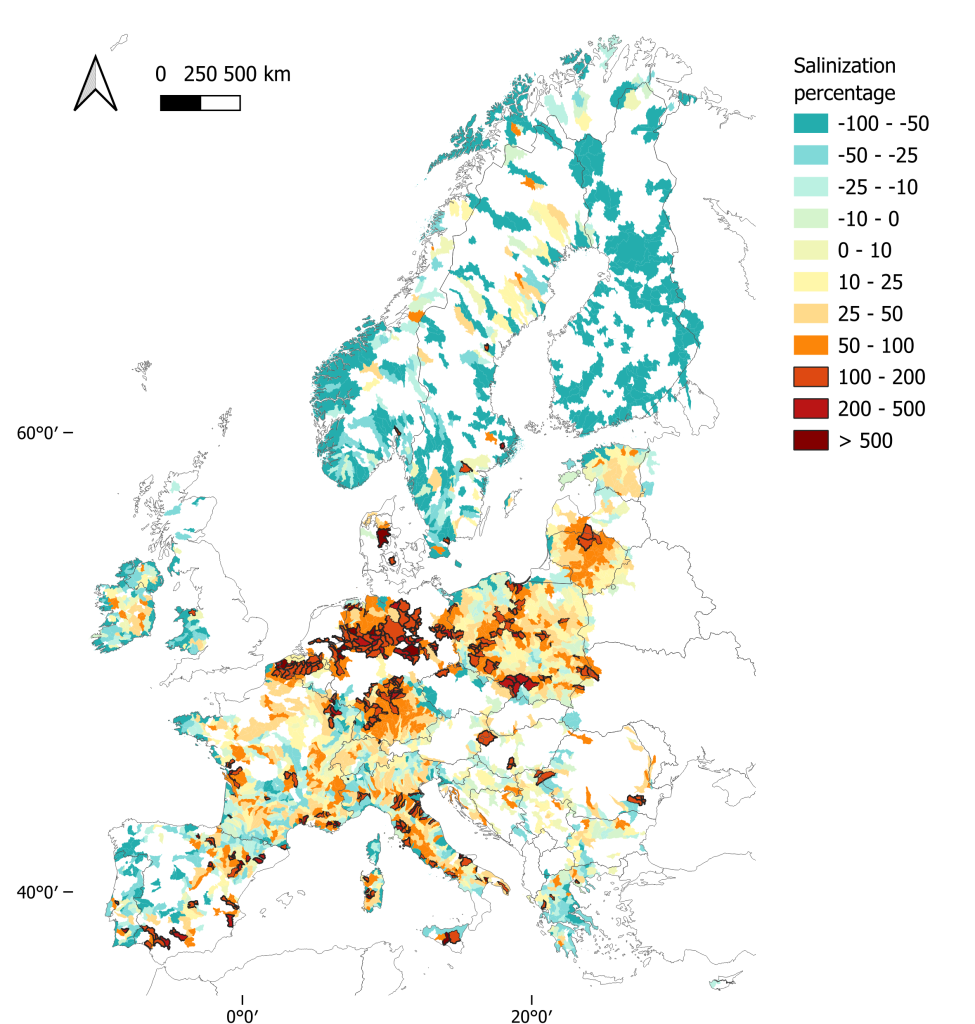
Freshwater salinisation across Europe. Percentage difference between observed salinity (electrical conductivity) and predicted natural levels. Black outlines indicate catchments with high certainty of salinisation. | Crabot et al., Nature Communications
Lack of salinisation standards
While recognised as a growing pressure on European freshwater ecosystems with mounting ecological and socioeconomic impacts, salinisation remains largely overlooked in existing EU and national water policies.
Twenty-five years after the adoption of the EU Water Framework Directive (WFD), which requires Member States to achieve “good ecological and chemical status” for surface waters, most countries still lack dedicated salinity standards and do not systematically monitor or report on salinity impacts.
“We should be measuring salinisation itself, the gap between expected natural salinity and observed levels, rather than total salinity, and establishing regulatory limits based on that difference. Once those are set, mitigation strategies will depend on the specific drivers of contamination,” concludes Cañedo-Argüelles.
Crabot, J., Mingarelli, S., Cunillera-Montcusí, D. et al. Rivers of salt: the extent of salinization in European running waters. Nature Communications (2026). DOI: 10.1038/s41467-026-76477-5