-
Today, 13 September, marks the first celebration of this day proclaimed by UNESCO, a global recognition dedicated to the education, conservation, and protection of the subterranean world.
-
IDAEA-CSIC joins this global initiative by highlighting the European KARST project, which aims to understand water flow and pollutant transport in caves worldwide.
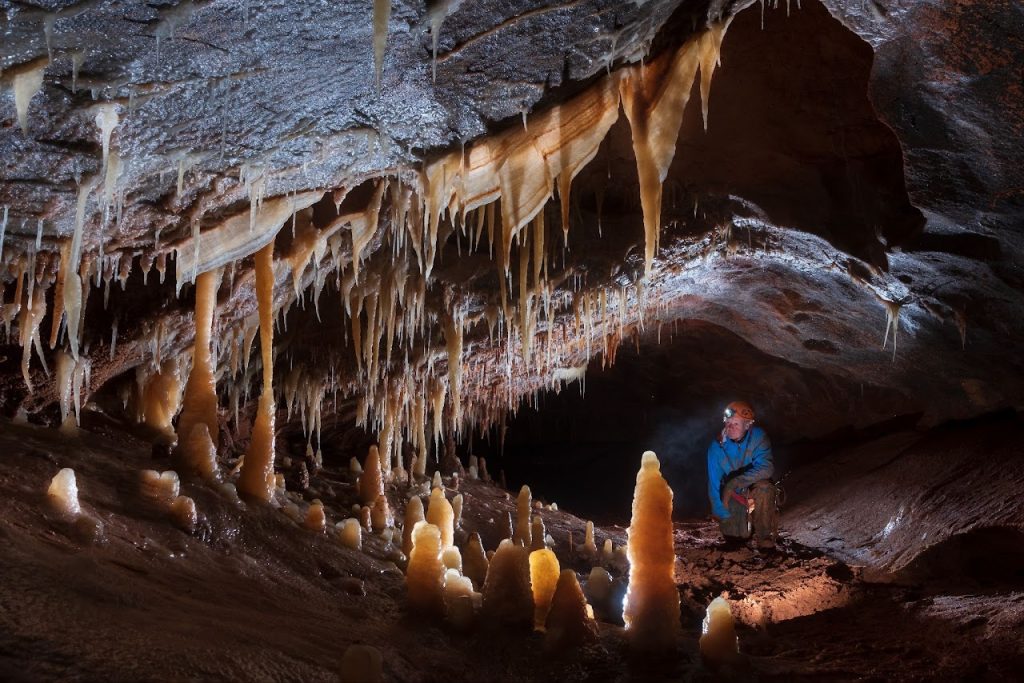
This year, 2026, marks the first edition of the International Day of Caves and Karst. | Florian Bachmann
13 September has been officially declared International Day of Caves and Karst. Proclaimed by UNESCO, this day (whose main events are held in Postojna, Slovenia, led by the Karst Research Institute ZRC SAZU and the International Union of Speleology) was established to raise awareness of the fragility and priceless value of these subterranean landscapes.
Karst formations and caves are estimated to cover nearly a quarter of the Earth’s land surface and provide drinking water to more than one billion people worldwide. Besides hosting unique subterranean biodiversity and an invaluable geological heritage, these ecosystems play a crucial role in the Sustainable Development Goals (SDGs), particularly in ensuring the availability of clean water (SDG 6). However, they remain fragile ecosystems that are highly vulnerable and largely unknown.
The European KARST project: Science to protect groundwater
In the current context of climate change, where severe droughts and intense storms are becoming increasingly frequent, understanding how water circulates underground is essential. Against this backdrop, IDAEA-CSIC is leading a line of hydrogeology research through the European KARST project.
Funded by a prestigious ERC Synergy Grant from the European Research Council (ERC) and coordinated by researcher Marco Dentz, this project addresses a major challenge: modelling and characterising subterranean cave systems worldwide to predict water flow and pollutant transport.
Because karst systems are formed from soluble rocks such as limestone, they create cave networks. Owing to the characteristics of limestone, water is not stored; instead, it flows at high speed through intricate networks of conduits.
“A cave is not a smooth, perfectly symmetrical pipe. Its walls are rough, fractured, and contain cavities where water forms eddies or can be temporarily stored,” explains Marco Dentz.
This extremely high flow velocity makes them exceptionally sensitive: during torrential rainfall, they can overflow and cause severe flooding, whilst following a chemical or agricultural spill, contamination can reach drinking water wells in a matter of hours or days.
To untangle these complex dynamics, the KARST project team is combining cave characterisation with laboratory-scale experiments and cutting-edge digital models. They have also created the world’s largest database of cave networks, compiling information on more than 172 karst systems (15 of them in Spain).
On this first International Day of Caves and Karst, everyone at IDAEA reaffirms our commitment to the study and protection of groundwater resources. Fundamental research in fluid physics, such as that developed by Marco Dentz and his team at the Porous media multiscale modeling laboratory, is proving to be highly pioneering and innovative in this field of hydrogeology.