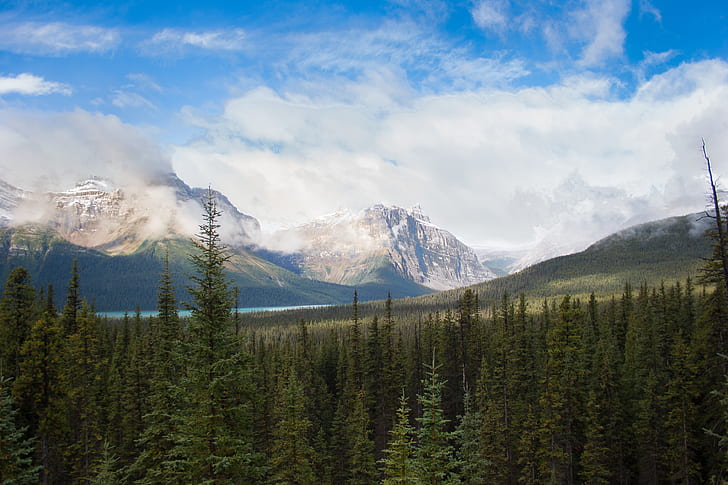
Climate change induced treeline displacement can affect the concentration, composition and reactivity of organic carbon in lakes at high altitude and latitude / PickPic
Climate change is causing an up- and northward displacement of the treeline – the important landscape feature demarking the limits of forest growth in mountain and subarctic environments. While the factors determining the position of the treeline are now well known, potential consequences of treeline displacement are less well understood. Experimental work of an international team led by the École Polytechnique Fédérale de Lausanne (EPFL), in Switzerland, and with the collaboration of the Institute of Environmental Assessment and Water Research (IDAEA-CSIC), published in Nature Communications, unraveled the impacts of treeline displacement on dissolved organic carbon biogeochemistry in alpine and subarctic lakes. Using molecular-level information of organic carbon, the team demonstrates that the shifting treeline has the potential to profoundly alter the composition and reactivity of organic carbon in these pristine ecosystems.
Lakes at high altitude and high latitude are very rich in aquatic organisms, and pelagic primary production represents the main source of organic carbon in these ecosystems. This organic carbon fuels the production of biomass by heterotrophic bacteria, which form the basis of foodwebs in these lakes. Working on a high-alpine lake in Austria (Gossenköllesee) and a lake located in Northern Lappland (Saanajaervi), in Finland, the scientists sought to shed light on the consequences of treeline displacement for lake carbon biogeochemistry.
“Although the samples were taken in Austria and Finland, these results can be applied to lakes all over the world, including the high-montain lakes Tres Estanys and Naorte, in the the Pyrenees”, explains Núria Catalan, IDAEA researcher and first author of the study.
The presence of coniferous trees is known to fundamentally alter soil-organic carbon concentration and composition, but what happens once this carbon reaches the lakes was unknown. By experimentally amending lake water with soil-derived organic carbon from above and below the treeline, the scientists could show that organic carbon from below the treeline represents novel chemodiversity in these ecosystems. This novel chemodiversity is enriched in polyphenolic and highly unsaturated molecules. Short- and long-term organic carbon degradation experiments showed that these compounds reduced overall dissolved organic matter reactivity, which was related to a reduced bacterial carbon use efficiency.
Taken together, this work shows that climate change induced treeline displacement can affect the concentration, composition and reactivity of organic carbon in lakes at high altitude and latitude, with yet unknown consequences for foodwebs and water quality. Globally, most lakes are small and located at high latitudes and thus particularly sensitive to changes in their catchments. Changes in the carbon biogeochemistry of these ecosystems may reduce their potential as carbon sinks.
Catalán, N., Rofner, C., Verpoorter, C. et al. Treeline displacement may affect lake dissolved organic matter processing at high latitudes and altitudes. Nat Commun, 15, 2640 (2024). DOI: 10.1038/s41467-024-46789-5

Climate change induced treeline displacement can affect the concentration, composition and reactivity of organic carbon in lakes at high altitude and latitude / PickPic
Climate change is causing an up- and northward displacement of the treeline – the important landscape feature demarking the limits of forest growth in mountain and subarctic environments. While the factors determining the position of the treeline are now well known, potential consequences of treeline displacement are less well understood. Experimental work of an international team led by the École Polytechnique Fédérale de Lausanne (EPFL), in Switzerland, and with the collaboration of the Institute of Environmental Assessment and Water Research (IDAEA-CSIC), published in Nature Communications, unraveled the impacts of treeline displacement on dissolved organic carbon biogeochemistry in alpine and subarctic lakes. Using molecular-level information of organic carbon, the team demonstrates that the shifting treeline has the potential to profoundly alter the composition and reactivity of organic carbon in these pristine ecosystems.
Lakes at high altitude and high latitude are very rich in aquatic organisms, and pelagic primary production represents the main source of organic carbon in these ecosystems. This organic carbon fuels the production of biomass by heterotrophic bacteria, which form the basis of foodwebs in these lakes. Working on a high-alpine lake in Austria (Gossenköllesee) and a lake located in Northern Lappland (Saanajaervi), in Finland, the scientists sought to shed light on the consequences of treeline displacement for lake carbon biogeochemistry.
“Although the samples were taken in Austria and Finland, these results can be applied to lakes all over the world, including the high-montain lakes Tres Estanys and Naorte, in the the Pyrenees”, explains Núria Catalan, IDAEA researcher and first author of the study.
The presence of coniferous trees is known to fundamentally alter soil-organic carbon concentration and composition, but what happens once this carbon reaches the lakes was unknown. By experimentally amending lake water with soil-derived organic carbon from above and below the treeline, the scientists could show that organic carbon from below the treeline represents novel chemodiversity in these ecosystems. This novel chemodiversity is enriched in polyphenolic and highly unsaturated molecules. Short- and long-term organic carbon degradation experiments showed that these compounds reduced overall dissolved organic matter reactivity, which was related to a reduced bacterial carbon use efficiency.
Taken together, this work shows that climate change induced treeline displacement can affect the concentration, composition and reactivity of organic carbon in lakes at high altitude and latitude, with yet unknown consequences for foodwebs and water quality. Globally, most lakes are small and located at high latitudes and thus particularly sensitive to changes in their catchments. Changes in the carbon biogeochemistry of these ecosystems may reduce their potential as carbon sinks.
Catalán, N., Rofner, C., Verpoorter, C. et al. Treeline displacement may affect lake dissolved organic matter processing at high latitudes and altitudes. Nat Commun, 15, 2640 (2024). DOI: 10.1038/s41467-024-46789-5