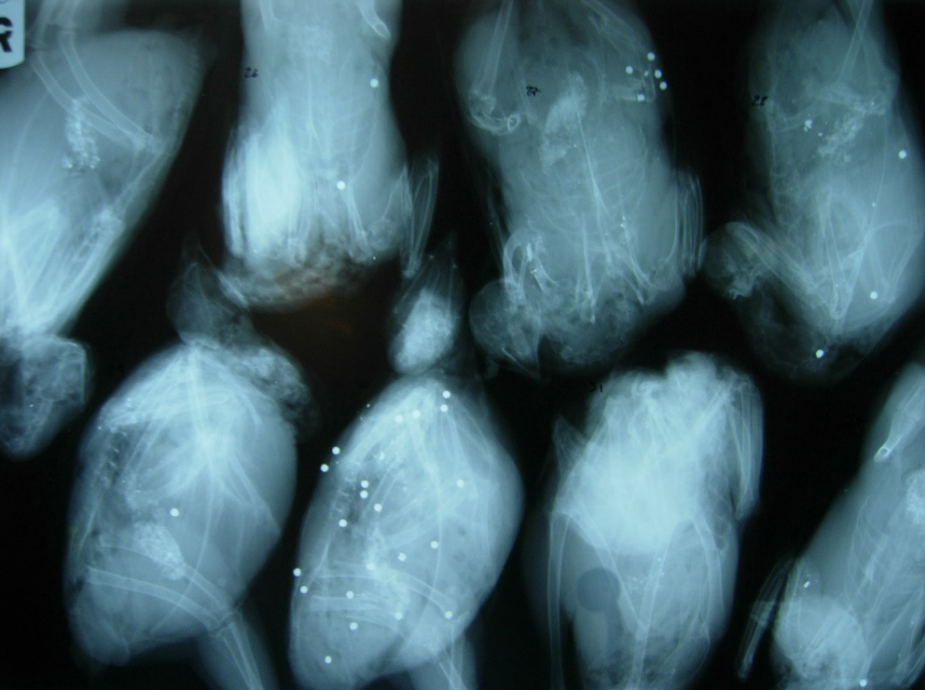
Red partridges hunted with lead shot embedded in their bodies / Rafael Mateo
Annually, it is estimated that around twenty thousand tons of lead are shot into the countryside in the European Union. Now, the report Lead poisoning in terrestrial birds in Spain: Pollution by lead ammunition beyond humid areas (El plumbismo en aves terrestres de España: Contaminación por la munición de plomo más allá de las zonas húmedas, in Spanish) made by the Institute of Environmental Assessment and Water Research (IDAEA-CSIC), together with the Institute for Game and Wildlife Research (IREC-CSIC-UCLM), and requested by the Spanish Ornithology Society (SEO Bird/Life), shows the impact that the use of lead has on biodiversity in Spain, as well as its potential damage to human health. The main result of the study is that lead poisoning affects all wild birds, besides generating pollution in soil, water and plants. This report is a bibliographic review with data updates, made by the IDAEA researcher Maria Dulsat, from the Chemometrics for Environmental Omics group, and IREC researcher Rafael Mateo, with all the analysed birds poisoned by lead ingestion in Spain.
Lead is an extremely toxic and bioaccumulative substance and its effects become chronic, and it has been eliminated from most of the uses that it had, such as water pipes. Spain has been a pioneer in banning the use of lead for hunting in wetlands, taking into account its toxicity, which not only affects aquatic birds but also terrestrial ones. This report shows that lead shots are ingested by granivorous birds, such as pigeons or partridges, but there is also a diffusion to plants that end up passing into the food chain. Birds ingest shots either by thinking they are grits, and therefore, they accumulate in their stomachs; or by feeding on other animals with lead ammunition embedded in their bodies. These lead concentrations might be lethal, although they frequently cause reproductive, physiologic and immunologic problems.
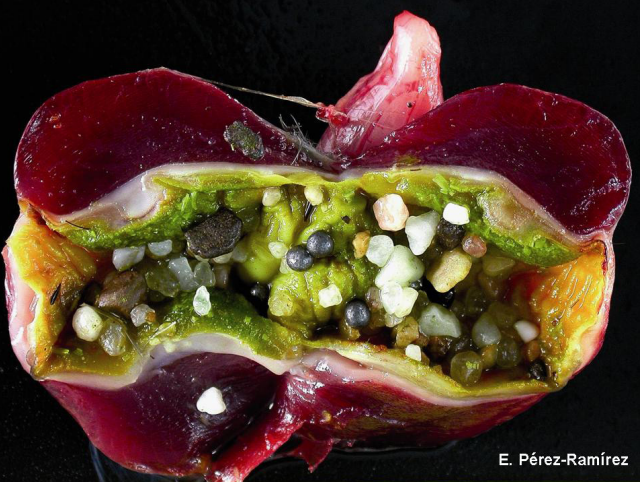
Partridge’s stomach with lead ingested / E. Pérez Ramírez
The study confirms that lead ammunition is also a significant source of lead in game meat intended for human consumption. European regulation establishes maximum regulations of lead residues suitable for human consumption of 0.5 µg/p.f. in viscera and 0.1 µg/p.f. in meat. However, around 50% of small game pieces and foods processed with large game meat exceed these levels, posing a risk to human health. Exposure to small doses of lead repeatedly causes chronic toxicity, damaging the nervous system, kidneys, bones, cardiovascular and immunologic system, and causing infertility.
The European Commission will soon have to decide on the restriction on lead ammunition for all types of hunting and outdoor sports shooting, besides the use of lead weights in fishing, at the proposal of the European Chemicals Agency (ECHA).

Red partridges hunted with lead shot embedded in their bodies / Rafael Mateo
Annually, it is estimated that around twenty thousand tons of lead are shot into the countryside in the European Union. Now, the report Lead poisoning in terrestrial birds in Spain: Pollution by lead ammunition beyond humid areas (El plumbismo en aves terrestres de España: Contaminación por la munición de plomo más allá de las zonas húmedas, in Spanish) made by the Institute of Environmental Assessment and Water Research (IDAEA-CSIC), together with the Institute for Game and Wildlife Research (IREC-CSIC-UCLM), and requested by the Spanish Ornithology Society (SEO Bird/Life), shows the impact that the use of lead has on biodiversity in Spain, as well as its potential damage to human health. The main result of the study is that lead poisoning affects all wild birds, besides generating pollution in soil, water and plants. This report is a bibliographic review with data updates, made by the IDAEA researcher Maria Dulsat, from the Chemometrics for Environmental Omics group, and IREC researcher Rafael Mateo, with all the analysed birds poisoned by lead ingestion in Spain.
Lead is an extremely toxic and bioaccumulative substance and its effects become chronic, and it has been eliminated from most of the uses that it had, such as water pipes. Spain has been a pioneer in banning the use of lead for hunting in wetlands, taking into account its toxicity, which not only affects aquatic birds but also terrestrial ones. This report shows that lead shots are ingested by granivorous birds, such as pigeons or partridges, but there is also a diffusion to plants that end up passing into the food chain. Birds ingest shots either by thinking they are grits, and therefore, they accumulate in their stomachs; or by feeding on other animals with lead ammunition embedded in their bodies. These lead concentrations might be lethal, although they frequently cause reproductive, physiologic and immunologic problems.

Partridge’s stomach with lead ingested / E. Pérez Ramírez
The study confirms that lead ammunition is also a significant source of lead in game meat intended for human consumption. European regulation establishes maximum regulations of lead residues suitable for human consumption of 0.5 µg/p.f. in viscera and 0.1 µg/p.f. in meat. However, around 50% of small game pieces and foods processed with large game meat exceed these levels, posing a risk to human health. Exposure to small doses of lead repeatedly causes chronic toxicity, damaging the nervous system, kidneys, bones, cardiovascular and immunologic system, and causing infertility.
The European Commission will soon have to decide on the restriction on lead ammunition for all types of hunting and outdoor sports shooting, besides the use of lead weights in fishing, at the proposal of the European Chemicals Agency (ECHA).