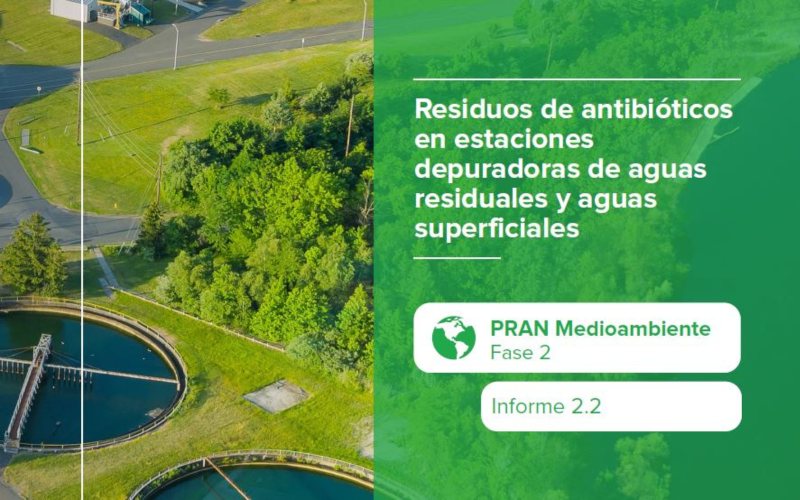
The National Plan against Antibiotic Resistance (Plan Nacional frente a la Resistencia de los Antibióticos, PRAN), coordinated by the Spanish Agency of Medicines and Medical Devices (AEMPS), has released Report 2.2 Antibiotic Residues in Wastewater Treatment Plants and Surface Waters. The report was conducted by the PRAN’s Environmental Resistance Working Group in collaboration with the Ministry for Ecological Transition and Demographic Challenge (MITECO) and the Institute of Environmental Assessment and Water Research (IDAEA-CSIC).
This new report unveils findings from a study that monitored the concentration of five antibiotics listed in the European Union’s Watch List at 16 Wastewater Treatment Plants and their associated rivers. Specifically, the analysis of the antibiotics was carried out by IDAEA technicians Arancha Bartolomé, Eva Mª Herrera, Cintia Flores, and Josep Caixach, from the Laboratory of Mass Spectrometry – Organic Pollutants at the IDAEA facilities. The samples from surface waters and wastewater treatment plants were assessed for erythromycin, clarithromycin, and azithromycin (2018 and 2019), ciprofloxacin, and amoxicillin (2019).
Key conclusions from Report 2.2 include:
- Higher antibiotic consumption does not necessarily correlate with greater environmental emissions. For instance, despite high consumption, amoxicillin is not the most frequently detected antibiotic.
- Samples taken from rivers generally exhibit lower antibiotic concentrations compared to those from wastewater treatment plants.
- Among the analyzed antibiotics, azithromycin is most frequently found in treatment plants, while ciprofloxacin dominates in rivers.
- Designing a monitoring program should consider factors such as sampling date (due to seasonal consumption patterns), inherent characteristics of each antibiotic (e.g., biodegradability, solubility), upstream antibiotic concentration, and the characteristics of both the treatment plant and the river (flow rate, presence or absence of quaternary treatments).
Aligned with PRAN’s surveillance approach, this document exemplifies the plan’s commitment to reinforcing its One Health strategy. It contributes valuable insights into the intricate role the environment plays in antibiotic resistance.

The National Plan against Antibiotic Resistance (Plan Nacional frente a la Resistencia de los Antibióticos, PRAN), coordinated by the Spanish Agency of Medicines and Medical Devices (AEMPS), has released Report 2.2 Antibiotic Residues in Wastewater Treatment Plants and Surface Waters. The report was conducted by the PRAN’s Environmental Resistance Working Group in collaboration with the Ministry for Ecological Transition and Demographic Challenge (MITECO) and the Institute of Environmental Assessment and Water Research (IDAEA-CSIC).
This new report unveils findings from a study that monitored the concentration of five antibiotics listed in the European Union’s Watch List at 16 Wastewater Treatment Plants and their associated rivers. Specifically, the analysis of the antibiotics was carried out by IDAEA technicians Arancha Bartolomé, Eva Mª Herrera, Cintia Flores, and Josep Caixach, from the Laboratory of Mass Spectrometry – Organic Pollutants at the IDAEA facilities. The samples from surface waters and wastewater treatment plants were assessed for erythromycin, clarithromycin, and azithromycin (2018 and 2019), ciprofloxacin, and amoxicillin (2019).
Key conclusions from Report 2.2 include:
- Higher antibiotic consumption does not necessarily correlate with greater environmental emissions. For instance, despite high consumption, amoxicillin is not the most frequently detected antibiotic.
- Samples taken from rivers generally exhibit lower antibiotic concentrations compared to those from wastewater treatment plants.
- Among the analyzed antibiotics, azithromycin is most frequently found in treatment plants, while ciprofloxacin dominates in rivers.
- Designing a monitoring program should consider factors such as sampling date (due to seasonal consumption patterns), inherent characteristics of each antibiotic (e.g., biodegradability, solubility), upstream antibiotic concentration, and the characteristics of both the treatment plant and the river (flow rate, presence or absence of quaternary treatments).
Aligned with PRAN’s surveillance approach, this document exemplifies the plan’s commitment to reinforcing its One Health strategy. It contributes valuable insights into the intricate role the environment plays in antibiotic resistance.