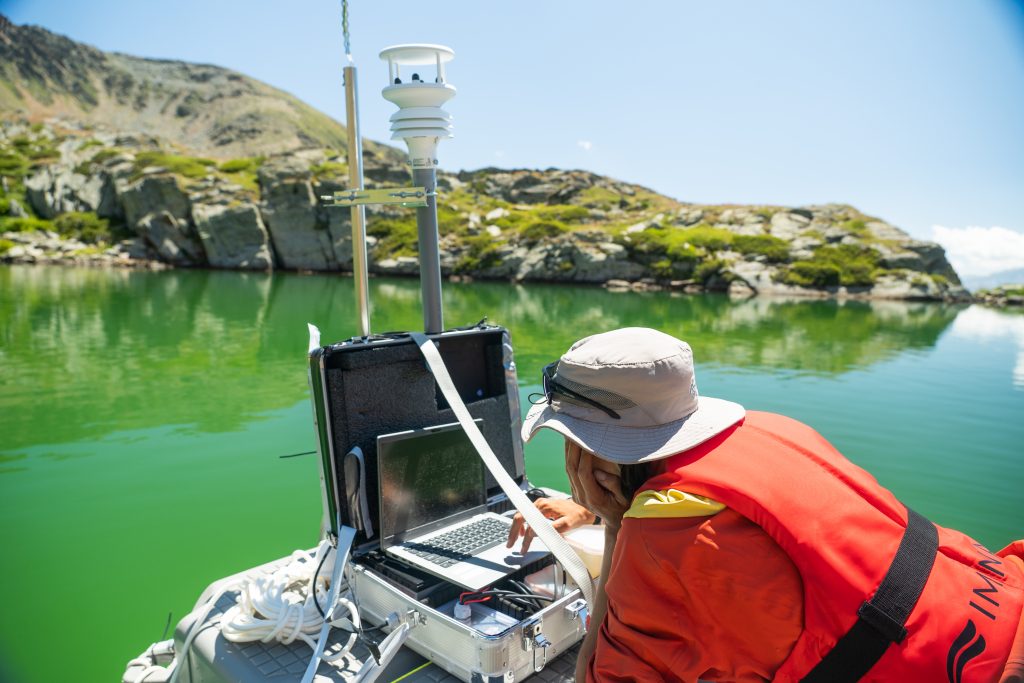
The carbon dioxide and oxygen monitors collected samples every ten minutes in Tres Estanys and Naorte lakes/ Source: Laura Carrau.
On the occasion of International Mountain Day, held on 11th December to demand the sustainable development of mountains, IDAEA-CSIC and Kilian Jornet Foundation coordinate to raise awareness about the protection and conservation of high-mountain lakes, specifically in the Alt Pirineu Natural Park in Lleida, with the LACOS and METAESTANY projects. These projects study the carbon cycle, the metabolism and the emissions of carbon dioxide of Tres Estanys and Naorte lakes to analyse the impact of climate change and the human print of these ecosystems.
Tres Estanys lake has been affected by the population of minnow, a fish introduced in Pyrenees lakes as fishing bait. This fish alters the food chain of the lakes, endangering native populations and potentially causing eutrophication of the waters, which translates into a massive growth of planktonic algae, giving the lake a green color. On the contrary, the Naorte pond has been recovering its crystalline waters thanks to several eradication and control projects of this species in recent years, such as RESQUALPYR.
“Monitoring the carbon dioxide and oxygen concentrations at different depths in the lake allows us to compare its gas emissions and to understand the metabolism within the water. Moreover, we measure the carbon dioxide in the basin air”, explains Núria Catalán, IDAEA-CSIC researcher and coordinator of the LACOS and METAESTANY projects. “With this data collection, we will be able to know if these high mountain lakes are sources or reservoirs of carbon into the atmosphere, in addition to knowing the effect of this restoration on greenhouse gas emissions.”
The final results of both studies are not yet known, although based on the first data, Naorte lake, where the elimination of minnow is now almost complete, acts as a carbon sink during the summer months.
The oxygen and carbon dioxide monitors were removed from the lakes last October, but the atmospheric sensors of carbon dioxide will continue to be installed in the basins and sending data to the project web.
These projects are financed by the Parc Natural de l’Alt Pirineu, the Fundació Catalana per a la Recerca i la Innovació, and are supported by the Joan Oró and Salvador Grau i Tort grants.
Nota de prensa (ESP)
Nota de premsa (CAT)

The carbon dioxide and oxygen monitors collected samples every ten minutes in Tres Estanys and Naorte lakes/ Source: Laura Carrau.
On the occasion of International Mountain Day, held on 11th December to demand the sustainable development of mountains, IDAEA-CSIC and Kilian Jornet Foundation coordinate to raise awareness about the protection and conservation of high-mountain lakes, specifically in the Alt Pirineu Natural Park in Lleida, with the LACOS and METAESTANY projects. These projects study the carbon cycle, the metabolism and the emissions of carbon dioxide of Tres Estanys and Naorte lakes to analyse the impact of climate change and the human print of these ecosystems.
Tres Estanys lake has been affected by the population of minnow, a fish introduced in Pyrenees lakes as fishing bait. This fish alters the food chain of the lakes, endangering native populations and potentially causing eutrophication of the waters, which translates into a massive growth of planktonic algae, giving the lake a green color. On the contrary, the Naorte pond has been recovering its crystalline waters thanks to several eradication and control projects of this species in recent years, such as RESQUALPYR.
“Monitoring the carbon dioxide and oxygen concentrations at different depths in the lake allows us to compare its gas emissions and to understand the metabolism within the water. Moreover, we measure the carbon dioxide in the basin air”, explains Núria Catalán, IDAEA-CSIC researcher and coordinator of the LACOS and METAESTANY projects. “With this data collection, we will be able to know if these high mountain lakes are sources or reservoirs of carbon into the atmosphere, in addition to knowing the effect of this restoration on greenhouse gas emissions.”
The final results of both studies are not yet known, although based on the first data, Naorte lake, where the elimination of minnow is now almost complete, acts as a carbon sink during the summer months.
The oxygen and carbon dioxide monitors were removed from the lakes last October, but the atmospheric sensors of carbon dioxide will continue to be installed in the basins and sending data to the project web.
These projects are financed by the Parc Natural de l’Alt Pirineu, the Fundació Catalana per a la Recerca i la Innovació, and are supported by the Joan Oró and Salvador Grau i Tort grants.
Nota de prensa (ESP)
Nota de premsa (CAT)