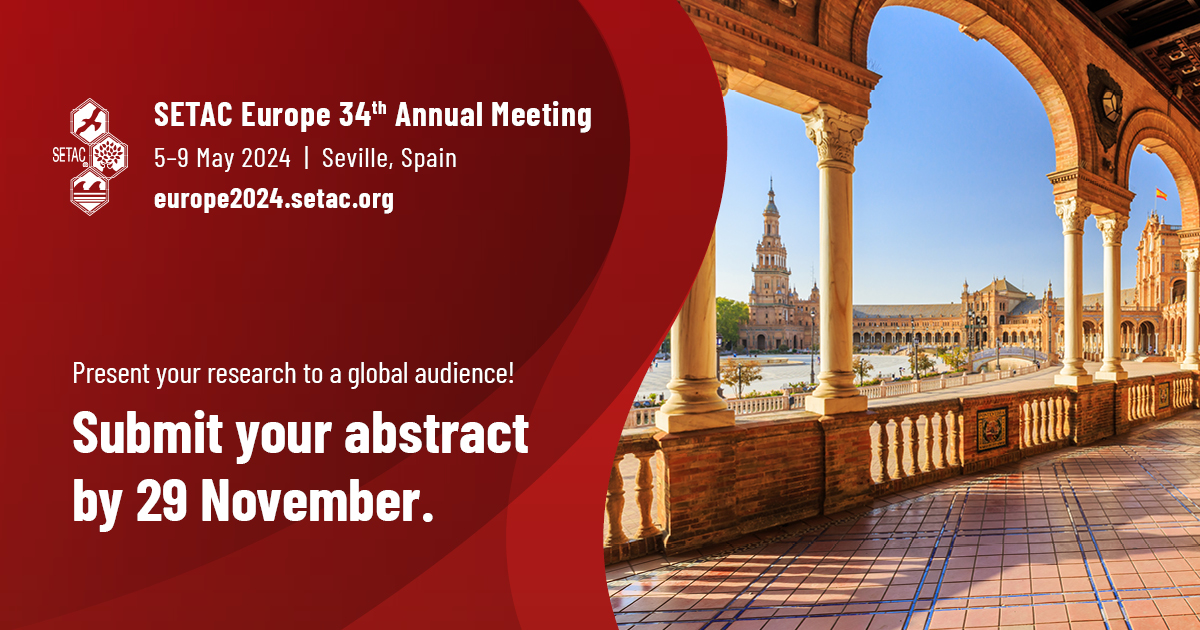
Abstract submission is now open for the SETAC Europe 34th Annual Meeting, which will be held from 5–9 May 2024. The meeting will be held in Seville, Spain, and will explore Science-Based Solutions in Times of Crisis: Integrating Science and Policy for Environmental Challenges.
Don’t miss your chance to be part of this meeting as it is an excellent opportunity to present and discuss emerging research in environmental toxicology and chemistry and to exchange ideas and experiences with experts from around the world. Several IDAEA researchers will be leading the following sessions as chairs. Check them out and submit your abstract for poster and oral presentations before 29 November 2023, 17.00 CET.
1. Environmental and Human Toxicology: From Molecules to Organisms, From Omics to in Vivo
- 1.02 | Advantages of using lab and field-collected invertebrates and in situ studies in ecotoxicology: challenges and opportunities in a global change scene
Carlos Barata, Ben Kefford, Claudia Rivetti, Jim Lazorchak - 1.05 | Behavioural toxicology: methodologies and research needs
Miguel Oliveira, Alex Ford, Demetrio Raldua, Minna Saaristo - 1.08 | Exploring long-term ecological impacts: from epigenetic biomarkers to multigenerational genomic effects of environmental contaminants
Jana Asselman, Som Niyogi, Laia Navarro, Ramji Bhandari
2. Ecotoxicology Becomes Stress Ecology: From Populations to Ecosystems and Landscapes
- 2.07 | Marine ecotoxicology: impacts and possible solutions, from coastal to deep-sea ecosystems
Marco Munari, Marinella Farré Urgell, Davide Asnicar, Daniela Pampanin
3. Environmental Chemistry and Exposure Assessment: Analysis, Monitoring, Fate and Modelling
- 3.05 | Analysis, assessment and management of contaminants of emerging concern and their transformation products in the environment
Nicola Montemurro, Daniel Zahn, Gabriel Sigmund, Sandra Pérez Solsona - 3.21 | Next-generation urban water management: improved understanding of the fate of micropollutants, transformation products, pathogens, and antimicrobial resistance
Stefan Kools, Despo Fatta-Kassinos, Ulla Bollmann, Marc Teixidó
- 3.30 | Unveiling the chemical exposome: insights from human biomonitoring and its influence on adverse health outcomes
Montse Marquès, Pablo Gago-Ferrero, Rubén Gil-Solsona, Adrià Sunyer-Caldú
4. Ecological and Human Health Risk Assessment of Chemicals, Mixtures and Stressors and Risk Mitigation Strategies
- 4.19 | Remediation technologies for contaminated water and soil
Sanne Smith, Michel Hubert, Victor Matamoros, Kai Bester
6. Environmental Policy, Risk Management, and Science Communication
- 6.15 | Science-policy dialogue on per- and poly-fluoroalkyl substances (PFASs) towards a PFAS-free future: latest development and future needs
Ian Cousins, Zhanyun Wang, Jordi Dachs

Abstract submission is now open for the SETAC Europe 34th Annual Meeting, which will be held from 5–9 May 2024. The meeting will be held in Seville, Spain, and will explore Science-Based Solutions in Times of Crisis: Integrating Science and Policy for Environmental Challenges.
Don’t miss your chance to be part of this meeting as it is an excellent opportunity to present and discuss emerging research in environmental toxicology and chemistry and to exchange ideas and experiences with experts from around the world. Several IDAEA researchers will be leading the following sessions as chairs. Check them out and submit your abstract for poster and oral presentations before 29 November 2023, 17.00 CET.
1. Environmental and Human Toxicology: From Molecules to Organisms, From Omics to in Vivo
- 1.02 | Advantages of using lab and field-collected invertebrates and in situ studies in ecotoxicology: challenges and opportunities in a global change scene
Carlos Barata, Ben Kefford, Claudia Rivetti, Jim Lazorchak - 1.05 | Behavioural toxicology: methodologies and research needs
Miguel Oliveira, Alex Ford, Demetrio Raldua, Minna Saaristo - 1.08 | Exploring long-term ecological impacts: from epigenetic biomarkers to multigenerational genomic effects of environmental contaminants
Jana Asselman, Som Niyogi, Laia Navarro, Ramji Bhandari
2. Ecotoxicology Becomes Stress Ecology: From Populations to Ecosystems and Landscapes
- 2.07 | Marine ecotoxicology: impacts and possible solutions, from coastal to deep-sea ecosystems
Marco Munari, Marinella Farré Urgell, Davide Asnicar, Daniela Pampanin
3. Environmental Chemistry and Exposure Assessment: Analysis, Monitoring, Fate and Modelling
- 3.05 | Analysis, assessment and management of contaminants of emerging concern and their transformation products in the environment
Nicola Montemurro, Daniel Zahn, Gabriel Sigmund, Sandra Pérez Solsona - 3.21 | Next-generation urban water management: improved understanding of the fate of micropollutants, transformation products, pathogens, and antimicrobial resistance
Stefan Kools, Despo Fatta-Kassinos, Ulla Bollmann, Marc Teixidó
- 3.30 | Unveiling the chemical exposome: insights from human biomonitoring and its influence on adverse health outcomes
Montse Marquès, Pablo Gago-Ferrero, Rubén Gil-Solsona, Adrià Sunyer-Caldú
4. Ecological and Human Health Risk Assessment of Chemicals, Mixtures and Stressors and Risk Mitigation Strategies
- 4.19 | Remediation technologies for contaminated water and soil
Sanne Smith, Michel Hubert, Victor Matamoros, Kai Bester
6. Environmental Policy, Risk Management, and Science Communication
- 6.15 | Science-policy dialogue on per- and poly-fluoroalkyl substances (PFASs) towards a PFAS-free future: latest development and future needs
Ian Cousins, Zhanyun Wang, Jordi Dachs