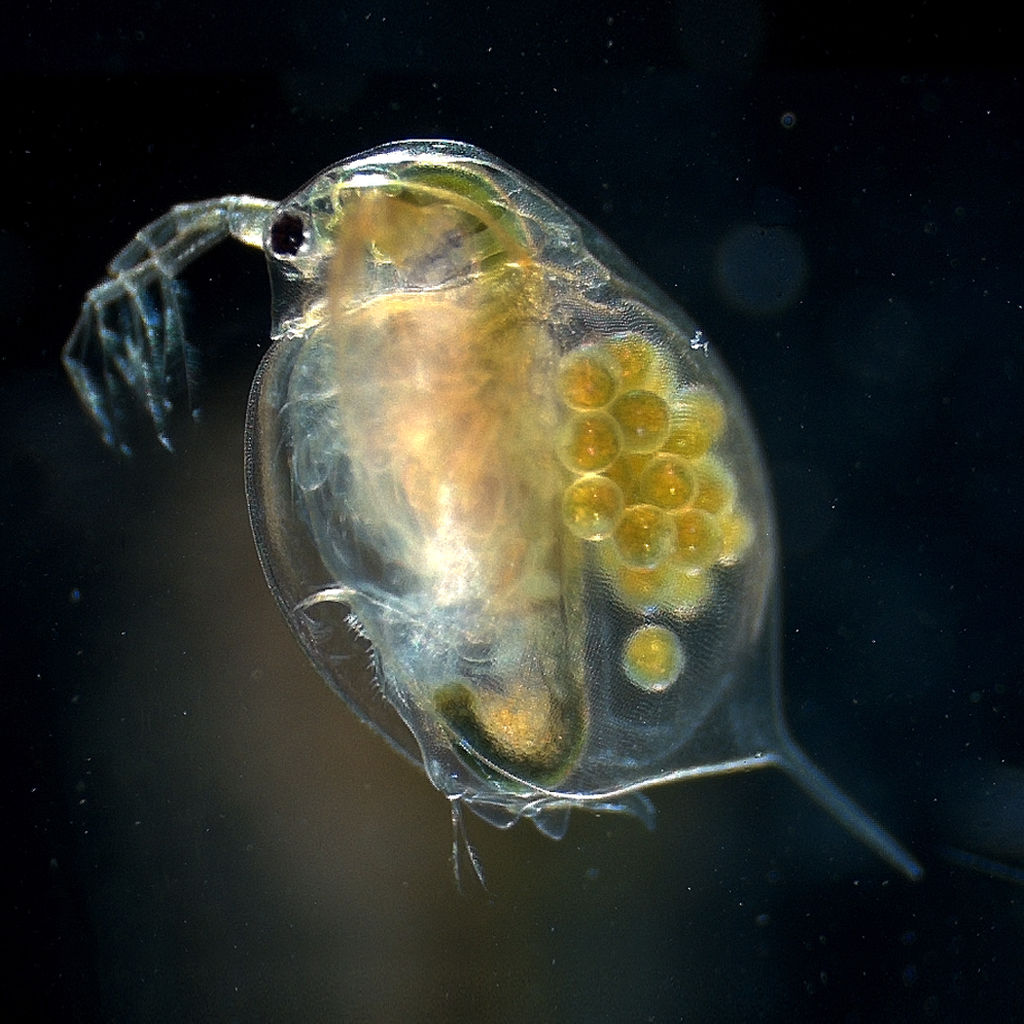
Daphnia magna suffered alterations in its behaviour, heart rate and at cellular level when exposed to cocaine, methamphetamine, ecstasy and ketamine. / Wikimedia
Four of the most commonly consumed illegal substances, like cocaine, methamphetamine, ecstasy and ketamine, have deleterious effects on the body, causing cognitive and behavioural alterations, heart diseases and oxidative stress in cells. A study conducted by the Institute of Environmental Assessment and Water Research (IDAEA-CSIC) and the Chemical Institute of Sarrià (IQS) investigated whether these same effects could be observed in Daphnia magna, a micro crustacean used as a model organism in environmental ecotoxicology. Published in Environmental Pollution, the work shows for the first time the alterations produced by these drugs at high concentrations, equivalent to those for human consumption, and at low concentrations that can be found in the environment. The results are as similar as those that a human being can have.
When exposed to cocaine, methamphetamine and ecstasy at high concentrations for 24 hours -equivalent to human consumption for 3 months- Daphnia magna suffered from increased locomotor activity and overexcitation in its behaviour to light stimuli. However, when exposed to ketamine, Daphnia reduced its ability to react to potential threats.
“The effects produced by these illegal drugs in Daphnia magna are the same to those observed in humans and in vertebrates models, such as mice or zebrafish, which allows us to replace them to taste drugs and contaminants”, explains Carlos Barata, IDAEA-CSIC researcher and main author of the study. “Daphnia is a low-cost maintenance organism, not bound by ethical regulations for animal experimentation, making it easier for us to evaluate the risks of chemical compounds.”
Neurological effects were also observed at acute concentrations. Dopamine levels increased when exposed to cocaine, but decreased to methamphetamine, whereas serotonin levels increased with ecstasy and cocaine.
“During the study, we noticed anxiety-related behaviours and a heightened response to light stimuli in Daphnia when exposed to these psychostimulant drugs”, confirms Cristian Gómez-Canela, IQS researcher and author of the study.
Daphnia was also exposed to low concentrations of 10, 100 and 1000 ng/L for 21 days, simulating common concentrations found in the environment, such as those in rivers, wastewater discharges, or soils. The results showed that the reproduction and growth of Daphnia were affected.
Nota de prensa (ESP)
Nota de premsa (CAT)
Marina Bellot, Fernando Soria, Raúl López-Arnau, Cristian Gómez-Canela, Carlos Barata. Daphnia magna an emerging environmental model of neuro and cardiotoxicity of illicit drugs. Environmental Pollution. DOI: 10.1016/j.envpol.2024.123355

Daphnia magna suffered alterations in its behaviour, heart rate and at cellular level when exposed to cocaine, methamphetamine, ecstasy and ketamine. / Wikimedia
Four of the most commonly consumed illegal substances, like cocaine, methamphetamine, ecstasy and ketamine, have deleterious effects on the body, causing cognitive and behavioural alterations, heart diseases and oxidative stress in cells. A study conducted by the Institute of Environmental Assessment and Water Research (IDAEA-CSIC) and the Chemical Institute of Sarrià (IQS) investigated whether these same effects could be observed in Daphnia magna, a micro crustacean used as a model organism in environmental ecotoxicology. Published in Environmental Pollution, the work shows for the first time the alterations produced by these drugs at high concentrations, equivalent to those for human consumption, and at low concentrations that can be found in the environment. The results are as similar as those that a human being can have.
When exposed to cocaine, methamphetamine and ecstasy at high concentrations for 24 hours -equivalent to human consumption for 3 months- Daphnia magna suffered from increased locomotor activity and overexcitation in its behaviour to light stimuli. However, when exposed to ketamine, Daphnia reduced its ability to react to potential threats.
“The effects produced by these illegal drugs in Daphnia magna are the same to those observed in humans and in vertebrates models, such as mice or zebrafish, which allows us to replace them to taste drugs and contaminants”, explains Carlos Barata, IDAEA-CSIC researcher and main author of the study. “Daphnia is a low-cost maintenance organism, not bound by ethical regulations for animal experimentation, making it easier for us to evaluate the risks of chemical compounds.”
Neurological effects were also observed at acute concentrations. Dopamine levels increased when exposed to cocaine, but decreased to methamphetamine, whereas serotonin levels increased with ecstasy and cocaine.
“During the study, we noticed anxiety-related behaviours and a heightened response to light stimuli in Daphnia when exposed to these psychostimulant drugs”, confirms Cristian Gómez-Canela, IQS researcher and author of the study.
Daphnia was also exposed to low concentrations of 10, 100 and 1000 ng/L for 21 days, simulating common concentrations found in the environment, such as those in rivers, wastewater discharges, or soils. The results showed that the reproduction and growth of Daphnia were affected.
Nota de prensa (ESP)
Nota de premsa (CAT)
Marina Bellot, Fernando Soria, Raúl López-Arnau, Cristian Gómez-Canela, Carlos Barata. Daphnia magna an emerging environmental model of neuro and cardiotoxicity of illicit drugs. Environmental Pollution. DOI: 10.1016/j.envpol.2024.123355