The study, led by IDAEA-CSIC, presents a new experimental tool to improve the safety of underground CO₂ storage.
Salt lake. | Angelo Villalobos on Pixabay
Geological storage of carbon dioxide (CO₂) is one of the most promising strategies to mitigate climate change. It consists of capturing the gas and injecting it into deep geological formations, such as former oil fields or saline aquifers. Understanding this process from a physical, geological, and hydrological perspective is highly complex, yet essential to ensure its safe and large-scale implementation.
Researchers from the Institute of Environmental Assessment and Water Research (IDAEA-CSIC) and the Institut de Recherche sur les Phénomènes Hors Équilibre (IRPHE) have developed a new experimental tool to better understand this process. The study, led by IDAEA researcher Juan J. Hidalgo, has been published in Physical Review Fluids and could help improve the safety and efficiency of underground CO₂ storage.
Why inject CO₂ into saline aquifers?
Saline aquifers, geological formations saturated with salty water, have an enormous capacity to store CO₂. This storage process has a particular feature: when injected, CO₂ becomes supercritical, an intermediate state between gas and liquid that occurs at high pressure and temperature. In this state, CO₂ is less dense than brine and therefore tends to rise, like a giant bubble.
Figure 3. Experimental fingering patterns. | Adapted from Benhammadi et al., 2025.
This behaviour poses a challenge: if CO₂ reaches fractures or abandoned wells, it could escape to the surface. To prevent this, it is crucial that the gas mixes thoroughly with the brine and dissolves within it.
The unstable mix of CO₂ and brine enhances underground storage
When supercritical CO₂ starts dissolving into brine, it forms an intermediate layer denser than either phase separately. This configuration (top: light CO₂; middle: denser CO₂–brine mixture; bottom: lighter brine) creates a physically unstable situation, similar to oil floating on water.
This instability produces what scientists call “fingering patterns”: branched structures that extend like fingers into the underlying liquid.
“These movements increase mixing between CO₂ and brine, which is positive because the more dissolved CO₂ is, the lower the chance of leakage, making the process safer overall,” explains Juan J. Hidalgo, IDAEA researcher and lead author of the study.
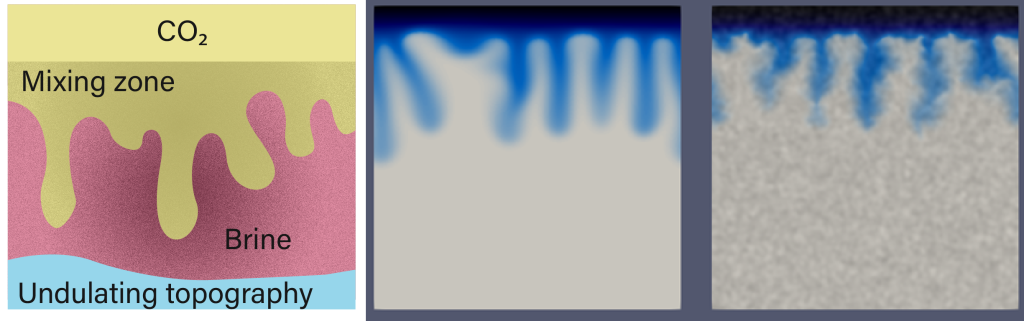
Graphic representation of fingering patterns during CO₂ injection. Simulations in a homogeneous medium (centre) and a heterogeneous one (right). | Juan J. Hidalgo
The new experiment better represents subsurface heterogeneity
Until now, these phenomena have been studied using numerical models or Hele-Shaw cells: two closely spaced transparent plates that simulate flow in porous media. However, such models are overly simplified, as they fail to capture real geological heterogeneity, that is, variations in subsurface shape and permeability.
The work by Rima Benhammadi, Patrice Meunier, and Juan J. Hidalgo introduces a key innovation: a new experimental cell with topography. This modified version of the Hele-Shaw cell includes reliefs and structures that mimic subsurface complexity. Thanks to this controlled topography, the researchers could precisely study how terrain irregularities affect the formation of fingering patterns and the efficiency of CO₂ storage.
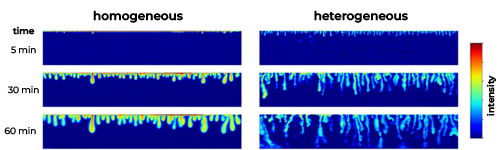
Figure 3. Experimental fingering patterns. | Adapted from Benhammadi et al., 2025.
What does the new experimental cell allow?
With the new Hele-Shaw cell including topography, researchers were able to quantify several parameters related to mixing instability, such as wavelength, number of fingers, and amplitude. Unlike previous studies focusing on dissolution fluxes, this work examines how geological heterogeneity modifies the instability pattern.
Although it is still not possible to predict exactly how a given geological structure will influence CO₂ behaviour, this experiment represents a major step forward.
“This study brings us closer to the ideal goal: being able to relate the parameters describing subsurface heterogeneity with the behaviour of instabilities—what shapes they take, how long they take to develop, and how they affect CO₂ dissolution,” concludes Hidalgo.
Alicia S. Arroyo
Communication and Outreach | IDAEA