
In a high emissions scenario, an increase in the average annual temperature of 5.5ºC is expected / Nicolas Longchamps, Flickr.
A new international study, published in The Lancet Planetary Health, authored by an international research team of the Multi-Country Multi-City (MCC) Collaborative Research Network, with the participation of IDAEA-CSIC, the Climate Research Foundation (FIC), and the University of Valencia, has analysed how global warming will affect the seasonality of mortality in different countries and climate zones, estimating the seasonal variation in mortality between the years 2000 and 2099 in 707 cities in 43 countries, which included the study of more than 125 million deaths.
Climate models were used to project the temperature variabilities and the authors estimated excess mortality associated with heat and cold in each country. Overall, seasonality showed high mortality in cold seasons and low mortality in warm seasons at the beginning of the century, although this pattern is less evident in tropical regions.
Between the years 2000 and 2099, an increase in average annual temperature of 1.4°C, 2.7°C, 4.3°C and 5.5°C is expected in the various scenarios of the Share Socioeconomic Pathways (SSP), which represents the different possibilities for future development, from a low emissions scenario until a high emissions scenario. The tropical and subtropical regions will have a severe impact, where the heat will become more extreme and prolonged.
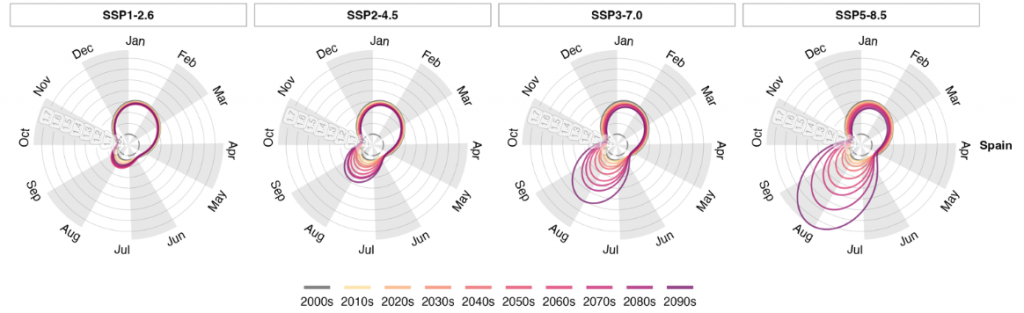
The heat-related mortality in Spain could increase a 70% in the 2090s./ Dominic Royé, Aurelio Tobías.
“Spain is especially vulnerable to climate change, due to its geographical situation, its aging demographic and its socioeconomic conditions”, says Dr. Dominic Royé, co-author of the study and researcher at the Climate Research Foundation.
In Spain, the study shows that the seasonal variation in mortality from all causes will be slightly reduced under the lowest emission scenario, but will increase under the other scenarios, especially under the highest emission scenario, which projects a +70% increase in mortality risk in summer and a -7.5% decrease in winter by 2090, compared to 2000. This implies that climate change could increase the burden of temperature-related mortality in Spain, especially during hot seasons.
“This is the first study to project seasonal variation in mortality under different climate change scenarios using a standardized methodology with comparable data between cities and countries at a global and regional level”, explains Dr. Aurelio Tobias, IDAEA-CSIC researcher and co-author of the study.
The results warn that the increase in heat-related deaths will significantly exceed the decrease in cold deaths, placing a greater burden on both health systems and society. For that reason, the authors urge health authorities in Spain to develop action plans that reduce exposure to non-optimal temperatures due to heat and cold, improve epidemiological surveillance and health care, and promote public awareness and education about the risks. for health associated with climate.
Madaniyazi, Lina, et al. Seasonality of mortality under climate change: a multicountry projection study. The Lancet Planetary Health (2024). DOI: 10.1016/S2542-5196(23)00269-3

In a high emissions scenario, an increase in the average annual temperature of 5.5ºC is expected / Nicolas Longchamps, Flickr.
A new international study, published in The Lancet Planetary Health, authored by an international research team of the Multi-Country Multi-City (MCC) Collaborative Research Network, with the participation of IDAEA-CSIC, the Climate Research Foundation (FIC), and the University of Valencia, has analysed how global warming will affect the seasonality of mortality in different countries and climate zones, estimating the seasonal variation in mortality between the years 2000 and 2099 in 707 cities in 43 countries, which included the study of more than 125 million deaths.
Climate models were used to project the temperature variabilities and the authors estimated excess mortality associated with heat and cold in each country. Overall, seasonality showed high mortality in cold seasons and low mortality in warm seasons at the beginning of the century, although this pattern is less evident in tropical regions.
Between the years 2000 and 2099, an increase in average annual temperature of 1.4°C, 2.7°C, 4.3°C and 5.5°C is expected in the various scenarios of the Share Socioeconomic Pathways (SSP), which represents the different possibilities for future development, from a low emissions scenario until a high emissions scenario. The tropical and subtropical regions will have a severe impact, where the heat will become more extreme and prolonged.

The heat-related mortality in Spain could increase a 70% in the 2090s./ Dominic Royé, Aurelio Tobías.
“Spain is especially vulnerable to climate change, due to its geographical situation, its aging demographic and its socioeconomic conditions”, says Dr. Dominic Royé, co-author of the study and researcher at the Climate Research Foundation.
In Spain, the study shows that the seasonal variation in mortality from all causes will be slightly reduced under the lowest emission scenario, but will increase under the other scenarios, especially under the highest emission scenario, which projects a +70% increase in mortality risk in summer and a -7.5% decrease in winter by 2090, compared to 2000. This implies that climate change could increase the burden of temperature-related mortality in Spain, especially during hot seasons.
“This is the first study to project seasonal variation in mortality under different climate change scenarios using a standardized methodology with comparable data between cities and countries at a global and regional level”, explains Dr. Aurelio Tobias, IDAEA-CSIC researcher and co-author of the study.
The results warn that the increase in heat-related deaths will significantly exceed the decrease in cold deaths, placing a greater burden on both health systems and society. For that reason, the authors urge health authorities in Spain to develop action plans that reduce exposure to non-optimal temperatures due to heat and cold, improve epidemiological surveillance and health care, and promote public awareness and education about the risks. for health associated with climate.
Madaniyazi, Lina, et al. Seasonality of mortality under climate change: a multicountry projection study. The Lancet Planetary Health (2024). DOI: 10.1016/S2542-5196(23)00269-3