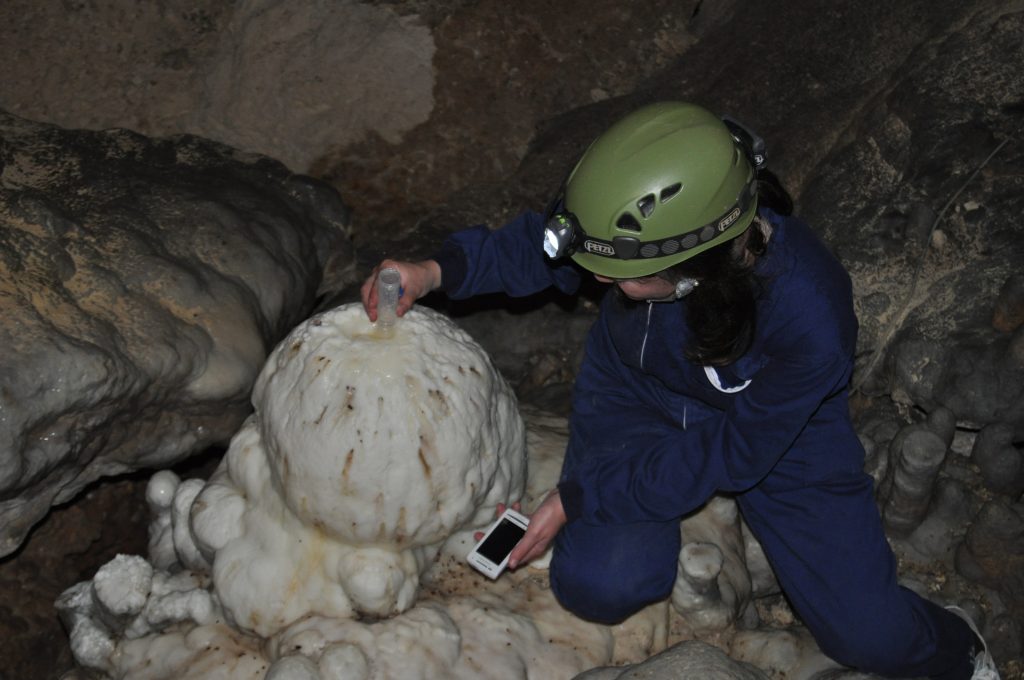
IDAEA researcher Belen Martrat taking a sample for the paleoclimatic archive. Source: Joan J. Fornós (Universitat de les Illes Balears)
It has recently been shown that the water cycle has changed over the last 2,000 years due to variations in temperature. This, however, was a result of global paleoclimatic records. Regarding the regional simulations, things change. Now, another study published in Nature Geoscience led by the Alfred Wegener Institute and the University of Tübingen, with the collaboration of the Institute of Environmental Assessment and Water Research (IDAEA-CSIC), shows that, although climate models correctly simulate global temperature trends, they often underestimate the strength of regional climate fluctuations, especially over the course of decades to centuries.
In order to understand the causes and consequences of climate fluctuations, researchers examine climate archives, such as trees, lakes and marine sediments, or even ice. Over the course of centuries and millennia, the climate has continuously varied, leaving behind traces. Understanding natural climate changes enables better assessments of what lies ahead with man-made climate change. Anticipating how humankind can prepare for the consequences of increasing global warming is of paramount importance.
“We will feel the effects of climate change primarily regionally, for instance in the Mediterranean Basin”, says IDAEA researcher Belen Martrat, author of the study. “In some regions, droughts will become more frequent, potentially leading to crop failures over extended periods. Elsewhere, we will witness more powerful weather phenomena.”
The problem is that global climate models are often unable to represent regional variations in detail when projecting several centuries into the future. While they are good at accurately simulating the global warming trend, they still lack the ability to accurately simulate local conditions. This makes it difficult to plan and implement concrete measures to adapt to the climate – for example, in agriculture to switch at the right time to crops that can tolerate higher temperatures. The research team already pointed out the problem of local predictive power about ten years ago: In an analysis of the climate evolution over the last 7000 years, they had then uncovered a striking discrepancy between global climate simulations on the one hand and local analysis of climate traces from centuries- or even millennia-old marine sediments, tree rings, pollen or corals. These indicators shed light on past temperatures in specific regions of the Earth. On a regional scale, climate simulations and sediment sample analyses differed in their temperature estimations, sometimes by a factor of 50, leading to controversial discussions among experts.
“At the time, we were faced with a conundrum,” recalls Thomas Laepple, main author of the study and Alfred Wegener Institute researcher. “We couldn’t say with certainty whether the climate models were incorrect in the selected examples or whether the temperature data derived from the sediment samples were based on faulty assumptions.”
Now a review article has been published in the journal Nature Geoscience, highlighting the discrepancies between the global and regional results. The most significant finding is that both sides are correct: the climate modeling experts and those who evaluate the climate traces.
“We found that climate models are skillful at tracing past global temperature trends,” says Laepple. “However, the longer the time period you examine, the more regional deviations are averaged out. Trends in regional temperature values become overly smoothed.”
One reason might be that global climate models do not account for various regional buffering phenomena – such as regional ocean currents that stabilize the climate in coastal regions for many years or even decades, even as the global average temperature changes.
Experts say that some regions may experience a cooling for a few years, while others may see temperatures significantly higher than the global average, and abrupt shifts are also possible. It is crucial to bear this in mind when conducting risk assessments for climate adaptation.
T. Laepple, E. Ziegler, N. Weitzel, R. Hébert, B. Ellerhoff, P. Schoch. B. Martrat, O. Bothe, E. Moreno-Chamarro, M. Chevalier, A. Herbert, K. Rehfeld: Regional but not global temperature variability underestimated by climate models at supra-decadal timescales; Nature Geoscience (2023). DOI: 10.1038/s41561-023-01299-9

IDAEA researcher Belen Martrat taking a sample for the paleoclimatic archive. Source: Joan J. Fornós (Universitat de les Illes Balears)
It has recently been shown that the water cycle has changed over the last 2,000 years due to variations in temperature. This, however, was a result of global paleoclimatic records. Regarding the regional simulations, things change. Now, another study published in Nature Geoscience led by the Alfred Wegener Institute and the University of Tübingen, with the collaboration of the Institute of Environmental Assessment and Water Research (IDAEA-CSIC), shows that, although climate models correctly simulate global temperature trends, they often underestimate the strength of regional climate fluctuations, especially over the course of decades to centuries.
In order to understand the causes and consequences of climate fluctuations, researchers examine climate archives, such as trees, lakes and marine sediments, or even ice. Over the course of centuries and millennia, the climate has continuously varied, leaving behind traces. Understanding natural climate changes enables better assessments of what lies ahead with man-made climate change. Anticipating how humankind can prepare for the consequences of increasing global warming is of paramount importance.
“We will feel the effects of climate change primarily regionally, for instance in the Mediterranean Basin”, says IDAEA researcher Belen Martrat, author of the study. “In some regions, droughts will become more frequent, potentially leading to crop failures over extended periods. Elsewhere, we will witness more powerful weather phenomena.”
The problem is that global climate models are often unable to represent regional variations in detail when projecting several centuries into the future. While they are good at accurately simulating the global warming trend, they still lack the ability to accurately simulate local conditions. This makes it difficult to plan and implement concrete measures to adapt to the climate – for example, in agriculture to switch at the right time to crops that can tolerate higher temperatures. The research team already pointed out the problem of local predictive power about ten years ago: In an analysis of the climate evolution over the last 7000 years, they had then uncovered a striking discrepancy between global climate simulations on the one hand and local analysis of climate traces from centuries- or even millennia-old marine sediments, tree rings, pollen or corals. These indicators shed light on past temperatures in specific regions of the Earth. On a regional scale, climate simulations and sediment sample analyses differed in their temperature estimations, sometimes by a factor of 50, leading to controversial discussions among experts.
“At the time, we were faced with a conundrum,” recalls Thomas Laepple, main author of the study and Alfred Wegener Institute researcher. “We couldn’t say with certainty whether the climate models were incorrect in the selected examples or whether the temperature data derived from the sediment samples were based on faulty assumptions.”
Now a review article has been published in the journal Nature Geoscience, highlighting the discrepancies between the global and regional results. The most significant finding is that both sides are correct: the climate modeling experts and those who evaluate the climate traces.
“We found that climate models are skillful at tracing past global temperature trends,” says Laepple. “However, the longer the time period you examine, the more regional deviations are averaged out. Trends in regional temperature values become overly smoothed.”
One reason might be that global climate models do not account for various regional buffering phenomena – such as regional ocean currents that stabilize the climate in coastal regions for many years or even decades, even as the global average temperature changes.
Experts say that some regions may experience a cooling for a few years, while others may see temperatures significantly higher than the global average, and abrupt shifts are also possible. It is crucial to bear this in mind when conducting risk assessments for climate adaptation.
T. Laepple, E. Ziegler, N. Weitzel, R. Hébert, B. Ellerhoff, P. Schoch. B. Martrat, O. Bothe, E. Moreno-Chamarro, M. Chevalier, A. Herbert, K. Rehfeld: Regional but not global temperature variability underestimated by climate models at supra-decadal timescales; Nature Geoscience (2023). DOI: 10.1038/s41561-023-01299-9