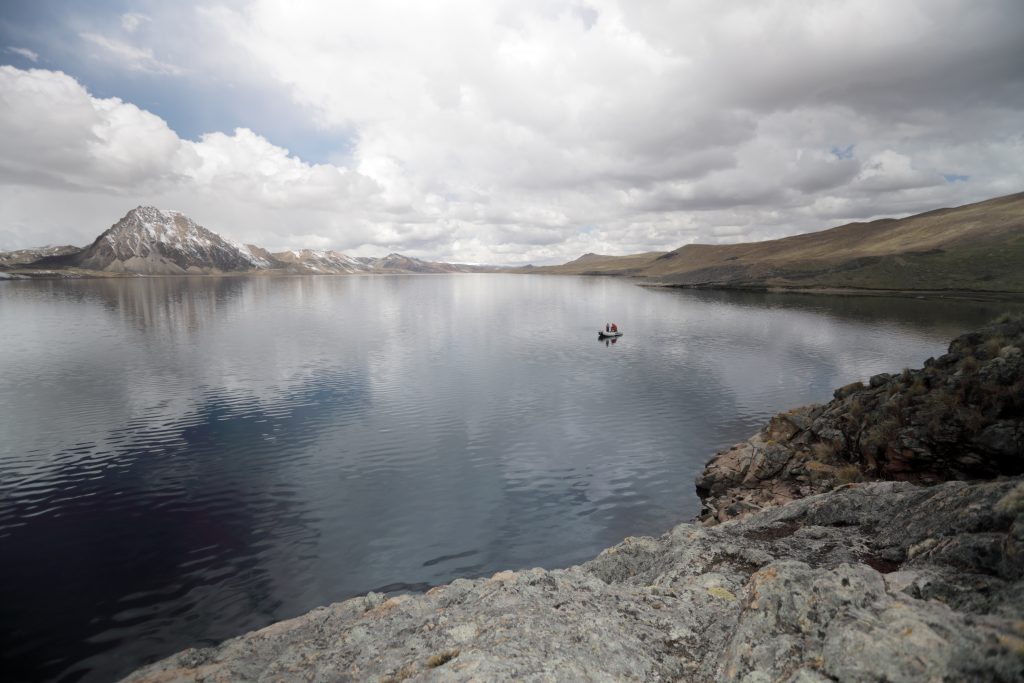
The study has compiled 759 paleoclimatic records to demonstrate changes in the global water cycle. / Source: Thomas Malkowicz, University of Washington, USA
An international study formed by institutions from 10 different countries, including the Institute of Environmental Assessment and Water Research (IDAEA-CSIC), takes an important step towards reconstructing the global history of water during the last 2,000 years. The work, published in the prestigious journal Nature Geoscience, has used geological and biological evidence preserved in natural archives, with up to 759 different paleoclimatic records of corals, trees, ice, cave formations, and sediments distributed globally. Researchers have shown that the global water cycle has changed during periods of warmer and colder temperatures in the recent past.
“This variety of terrestrial and marine geological records provides a global and regional vision of the last 2,000 years that greatly expands the data we had available until now. This is allowing us to put into temporal and geographical context the drought that we are suffering in geographical zones such as the Iberian Peninsula and the Mediterranean basin”, explains Belen Martrat, IDAEA-CSIC researcher and author of the study.
The water cycle is complex and the precipitation, in particular, has geographical variations that are much more drastic than air temperature. This has made it difficult for scientists to assess how precipitations have changed in the last millennia.
“To do this, we decided to study in depth the atoms that make up water molecules. Specifically, we study the variations of these atoms, called isotopes, which reflect very complex signs that, moreover, are recorded in all types of different natural archives”, explains Bronwen Konecky, assistant professor at the Washington University in St. Louis (USA) and first author of the study. “This is a first step to reconstruct the drought or rainfall patterns on a global scale during the last 2,000 years”.
Nota de prensa (ESP)
Nota de premsa (CAT)
Konecky B. L., McKay N. P., Falster G. M. et al. 2023. Globally coherent water cycle response to temperature change during the past two millennia. Nature Geosciences; doi: 10.1038/s41561-023-01291-3

The study has compiled 759 paleoclimatic records to demonstrate changes in the global water cycle. / Source: Thomas Malkowicz, University of Washington, USA
An international study formed by institutions from 10 different countries, including the Institute of Environmental Assessment and Water Research (IDAEA-CSIC), takes an important step towards reconstructing the global history of water during the last 2,000 years. The work, published in the prestigious journal Nature Geoscience, has used geological and biological evidence preserved in natural archives, with up to 759 different paleoclimatic records of corals, trees, ice, cave formations, and sediments distributed globally. Researchers have shown that the global water cycle has changed during periods of warmer and colder temperatures in the recent past.
“This variety of terrestrial and marine geological records provides a global and regional vision of the last 2,000 years that greatly expands the data we had available until now. This is allowing us to put into temporal and geographical context the drought that we are suffering in geographical zones such as the Iberian Peninsula and the Mediterranean basin”, explains Belen Martrat, IDAEA-CSIC researcher and author of the study.
The water cycle is complex and the precipitation, in particular, has geographical variations that are much more drastic than air temperature. This has made it difficult for scientists to assess how precipitations have changed in the last millennia.
“To do this, we decided to study in depth the atoms that make up water molecules. Specifically, we study the variations of these atoms, called isotopes, which reflect very complex signs that, moreover, are recorded in all types of different natural archives”, explains Bronwen Konecky, assistant professor at the Washington University in St. Louis (USA) and first author of the study. “This is a first step to reconstruct the drought or rainfall patterns on a global scale during the last 2,000 years”.
Nota de prensa (ESP)
Nota de premsa (CAT)
Konecky B. L., McKay N. P., Falster G. M. et al. 2023. Globally coherent water cycle response to temperature change during the past two millennia. Nature Geosciences; doi: 10.1038/s41561-023-01291-3