


The mission of ONHEALTH group is to enhance the understanding of the sources, occurrence, fate and behavior of pollutants of anthropogenic and biogenic origin and their impact on the environment and human health.
The major focus is on engineered systems, aquatic environments, terrestrial habitats, and the exposure to living organisms. To achieve these goals, we employ four main research lines:
1) Chemical and biological analysis to reliably detection and measurement at ultra-trace levels of contaminants in different matrices
2) Conduct controlled conditions experiments at our research facilities
3) Assess the impact of complex mixtures in environment and humans,
4) Assess the biota and human exposure through different routes (dietary, inhalation, dermal).
Our research on organic pollutants focuses mainly on four topics:
- Sampling and Biochemical Analyses
- Impact assessment studies
- Assessment of processes, such as biomagnification or bioaccumulation
- Experiments under controlled conditions
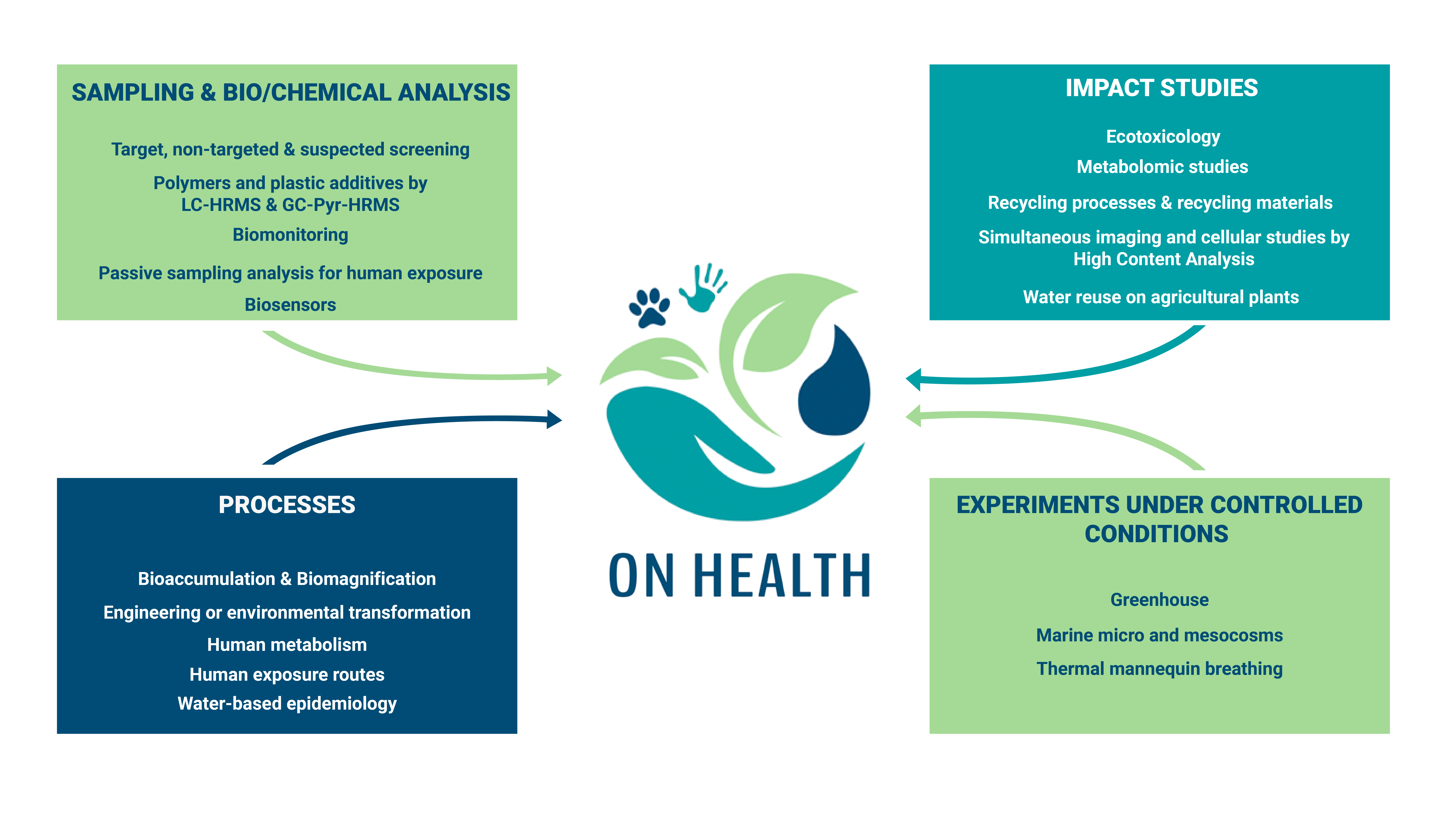
Sampling and chemical and biological analyses to reliably detect and measure at ultra-trace levels contaminants in different matrices, developing:
- sophisticated analytical methodologies (target, suspect and non-target approaches)
- methodologies for the analysis of polymers and plastic additives
- bio and passive sampling
- biosensors
Controlled condition experiments at our research facilities:
- greenhouse for cultivation of crops and installation of nature-based solutions
- marine micro/mesocosm emulating real conditions for accumulation studies and metabolomics studies
- thermal mannequin heads with breading system for the assessment of the real impact of contaminants present in indoor/outdoor or in different materials through breathing
Impact assessment through studies of:
- toxicological studies: standardized ecotoxicity tests, cell-lines toxicological studies with high-content analysis (HCA)
- metabolomic studies based on high resolution mass spectrometry
- impact of recycling processes and recycled materials
- water reuse on agricultural crops
Assessment of different processes, such as:
- bioaccumulation and biomagnification of pollutants along aquatic and terrestrial food chains
- transformations in natural or engineered systems
- human metabolism for exposure assessment
- water-based epidemiology
- human exposure through different routes: diet, inhalation and dermal contact
Our strategic plan is based on the development of frontier research and the training of new researchers together with an intense and effective fund raising through competitive calls and collaborations with public bodies and private companies.
ONHEALTH has an extensive network of collaborations:
- At national level: ACA, Agència de Residus de Catalunya, Agència de Salud Pública de Catalunya, Banco de Leche-Banc de Sang i Teixits de Catalunya, ICMAN, ICRA, IEO, ISGlobal, UB, UAB, UV, URiV, Parque Nacional de Doñana, Parque Nacional Tablas de Daimiel, Bioinicia S.L., ARPE S.L.
- At international level: University of New York (Buffalo, USA), CAPSENZE (Sweden), CONICET (Argentina), Universidad de Jijel (Algeria), CERTE (Tunisia), Florida International University (Miami, USA), Hebrew University of Jerusalem (Israel), UFZ (Germany), Université de Montpellier (France), INL (Portugal), RWTH (Germany), TUD (Germany), NIVA (Norway), IPMA (Portugal), among others.
Research Facilities
Instrumentation for chemical analysis
Sample collection, preparation and extraction:
- Freezer/Mill
- Quechers multi vortex
- Thermo block for incubation of human assays
- Evaporator SyncorePlus Analyst to perform a fast and gentle evaporation process with vacuum-vortex evaporation
- Extraction and purification of liquid samples by off-line solid phase extraction techniques.
- On-line extraction and purification:
- Turbulent flow chromatography (TurboFlow, Thermo Fisher) coupled to LC-QqQ-MS
- EQuan (Thermo Fisher Scientific) coupled to LC-QqQ-MS
- Extraction of solid samples:
- Pressurized liquid extraction – ASE 350 (Dionex)
- ONE PSE (Applied Separations)
Analysis by means of liquid chromatography coupled to mass spectrometry (LC-MS):
- Target analyses: LC-QqQ-MS, TSQ Vantage (Thermo Fisher Scientific)
- Suspect and non-target analyses: UHLPC-Orbitrap-MS, Q-Exactive (Thermo Electron)
Antropogenic particles (micro/nanoplastics and nanomaterials equipments)
- Spectrophotometer (Jenway 6062)
- Swift M10 Advanced Binocular Microscope
- Nanotracking analysis
- Pirolysis
Ecotox and biosensors lab
- Microtox® system (Azur)
- Spectrophotometer (Jenway 6062)
- ToxAlert 100 (Merck)
- Abratox Camera (Abraxis)
- Incubators with lateral illumination (Aqualytic)
- Cellular toxicity suit
- High content analysis (HCA) facilities
- Cell-lines suit access
- Cell-Insight NxT reader (Thermo)
- CellCense – Amperometric whole cell biosensor
- Microliter Plate readers and washers
Controlled conditions experiment facilities
- Greenhouse for cultivation of crops and installation of nature-based solutions
- Marine microcosms and mesocosms
- Thermal mannequin heads with breathing system
Desarrollo de una plataforma inteligente de modelización y virtualización de recursos hídricos
PLEC2023-010215
En la actualidad, en la mayoría de los países del mundo es ejercida una presión sin precedentes sobre los recursos hídricos, con una población creciente y un escenario donde el cambio climático supone un factor de condicionalidad añadido a la escasez de estos recursos. Para el año 2030, según estimaciones de la FAO, la diferencia entre demanda y suministro disponible a nivel mundial será del 40%, realidad a la que, lejos de ser ajena, España es un país muy directamente afectado por esta problemática. En este sentido, las estimaciones de riesgo de desertificación de España, estimadas por el Ministerio para la Transición Ecológica y el Reto Demográfico, hacen saltar todas las alarmas, mostrando que 2/3 partes del territorio español se encuentran potencialmente afectadas por este proceso. Es necesario actuar con urgencia, afrontando el problema con nuevas herramientas, con capacidad y con innovación y E-HYDRO está llamado a ser una herramienta clave para ello.
Ante la problemática e imperiosa necesidad existente, identificada igualmente en la inclusión de esta temática dentro de los objetivos del programa Transmisiones 2023, la solución E-HYDRO dará respuesta mediante la dotación de capacidades altamente innovadoras para la Gestión de los Recursos Hídricos. Así, E-HYDRO permitirá una gestión a nivel Cuenca Hidrográfica y su red fluvial asociada, en la que el usuario contará con un Gemelo Digital de la cuenca, asistido por herramientas de virtualización y modelización con motores de inteligencia artificial específicamente desarrollados. E-HYDRO permitirá así consultar, simular y prevenir escenarios reales o potenciales en aras de la asistencia precisa a la toma de decisiones para la mejor gestión del recurso agua.
Proyecto PLEC2023-010215 financiado por MICIU/AEI/10.13039/501100011033
Start Date: 01/01/2024 – End Date: 31/12/2027
Funding: National Project
https://e-hydro.es/

Integrated approach to assess the levels and impact of cONtaminants of Emerging concern on BLUE health and biodiversity modulated by climate change drivers.
101134929
The ONE-BLUE project aims to address the growing concerns about emerging contaminants (CECs) in marine environments. CECs can be found in pharmaceuticals, personal care products, flame retardants, pesticides, plastic additives, and micro- and nanoplastics. These contaminants pose a significant risk to marine ecosystems and biodiversity. Moreover, climate change exacerbates these risks by altering marine conditions, contaminant behaviour, and ocean acidification. The project seeks to enhance understanding of the presence, behaviour, and impacts of CECs in marine ecosystems under the influence of climate change.
ONE-BLUE focuses on developing new monitoring tools, advanced methodologies, and a comprehensive database (CECsMarineDB) to support effective management and policy decision-making. The studies include sampling campaigns in selected marine areas—the Atlantic Ocean, the Arctic, and the Mediterranean Sea—as well as controlled marine mesocosm experiments to investigate the interactions between CECs and climate change. Additionally, the project employs machine learning-based predictive models to assess and forecast future impacts. The project outcomes will be widely disseminated, and exploitation plans will be established to ensure the effective application of the developed technologies.
Funding: European Union’s HORIZON-CL6-2023-ZEROPOLLUTION-01 Ref No. 101134929
Start Date: 01/01/2024 – End Date: 30/06/2027
Funding: European Project
https://one-blue.eu/

AnguillaMed
Estat sanitari de les anguiles europees d’estanys i cursos fluvials de la Mediterrània occidental: desenvolupament de mètodes no invasius d’estudi de fonts de contaminació i proposta de mesures de restauració
El projecte AnguillaMed analitzarà l’estat sanitari de les poblacions d’anguila europea (Anguilla anguilla) a la Mediterrània occidental, desenvolupant mètodes no invasius per a l’estudi de fonts de contaminació i fent propostes de mesures de restauració del seu estat sanitari. Des de mitjans del s. XX, la població d’anguila europea s’ha reduït a tot el món fins a tenir una presència mínima. Es calcula que els últims 50 anys els efectius d’aquesta espècie tan vulnerable s’han reduït a menys del 95%. Les causes principals en són la sobrepesca, la ruptura de la connectivitat ecològica, l’elevada la contaminació química de l’aigua i infestacions parasitàries, entre altres. Aquest projecte farà un estudi de camp que inclourà 12 llocs d’estudi, que corresponen a diverses masses d’aigua. D’entrada, a la demarcació dels Pirineus Orientals, a la de Girona i a la de Barcelona.
Els resultats del projecte permetran conèixer els nivells de degradació i l’estat ecològic dels ambients o hàbitats aquàtics continentals, llacunes costaneres i cursos fluvials i centrar-se en les causes del declivi de la biodiversitat: l’alteració de la hidromorfologia i la hidrodinàmica, la contaminació difusa d’origen agrari o industrial, etc. A partir d’aquí, i tenint en compte que l’anguila és una espècie indicadora de la qualitat del medi aquàtic, la intenció és proposar les mesures de restauració més adequades per a aquests hàbitats, de comú acord amb els grups socials d’interès de cada lloc d’estudi. Els resultats de la recerca també es considera que puguin ser extrapolables a altres regions mediterrànies i europees.
Start Date: 01/01/2024 – End Date: 31/12/2026
Funding: European Project
https://anguillamed.eu/
Partnership for the assessment of risks from chemicals
101057014
The European Partnership for the Assessment of Risks from Chemicals (#EU_PARC) aims to advance research, share knowledge, and improve skills in chemical risk assessment. By doing so, it will help support the European Union's Chemicals Strategy for Sustainability, paving the way for the "zero pollution" ambition announced in the European Green Deal.
Main objectives:
- Develop the scientific skills needed to address current and future challenges in chemical safety
- Provide new data, methods, and innovative tools to those responsible for assessing and managing the risks of chemical exposure
- Strengthen the networks which bring together actors specialised in the different scientific fields contributing to risk assessment
PARC represents a campaign of unprecedented scale, since it brings together 200 partners from 28 countries, as well as three EU agencies (the European Environment Agency – EEA, the European Chemicals Agency – ECHA, and the European Food Safety Authority – EFSA). The partnership encompasses all aspects of chemical risk assessment, aiming in particular to: better anticipate emerging risks, better account for combined risks, and underpin the concrete implementation of new orientations in European public policies to safeguard the health and the environment in response to important issues for health, the ecology and citizens' expectations.
The Spanish coordination was assigned to the IDAEA's Geochemistry and Pollution group (Joan Grimalt) and the Instituto Carlos III.
HORIZON-HLTH-2021-ENVHLTH-03: 101057014
Start Date: 01/05/2022 – End Date: 30/04/2029
Funding: European Project
https://www.eu-parc.eu/
Staff
Permanent Researchers
PhD Students
Postdoc Researchers
Technical







