


The Groundwater and Hydrogeochemistry group studies the hydraulic, chemical, thermal and mechanical processes that take place in porous media from pore to regional scale. The group employs mathematical and numerical approaches as well as laboratory and field scale experiments and sampling methods (using hydraulic, hydro-geochemical and environmental isotope data sampled directly or through specifically designed tests).
The group is active in the development of numerical and mathematical models and modelling techniques for complex porous media processes across spatial and temporal scales, laboratory and field scale experimentation and sampling and data analysis. This includes geospatial data and information management.
Applications include the assessment and management of groundwater resources, groundwater and soil remediation, the management of urban aquifers, the study of emerging pollutants in urban aquifers and artificial recharge facilities, the study of wetlands, seawater intrusion in coastal aquifers, water management in mining operations, civil works, storage of waste and/or its recovery, water decontamination methodologies, the study of the unsaturated zone, the study of the hydro-thermo-mechanical and chemical processes associated with the injection and extraction of fluids at great depth (storage of CO2, storage of nuclear waste, geothermal energy, shale gas, induced seismicity).
- Artificial recharge
- Emerging contaminants in groundwater
- Environmental Geochemistry
- Geochemical modeling
- Geologic carbon storage
- Geomechanics
- Geothermics
- Groundwater modeling and inverse problem
- Hydrogeochemistry
- Hydrogeology in mining areas and civil works
- Induced seismicity
- Low temperature geochemistry
- Multiphase flow in porous media
- Heterogeneity
- Flow and reactive transport in porous media
- Mixing and dispersion in porous media
- Reactive mixing in porous media
- Stochastic modeling and upscaling of porous media processes
- Tools and software development
- Urban hydrogeology
BIODECLOR
Tecnologías emergentes para la bioremediación in situ de acuíferos contaminados con COVs clorados: validación a escala de campo y guía de apoyo a la toma de decisiones
Este proyecto con referencia RDI001/24/000002 ha sido financiado por la Generalitat de Catalunya, en el marco de la convocatoria ACC/1362/2024, gestionada por la Agència Catalana de l’Aigua (ACA)
Start Date: 05/07/2025 – End Date: 04/07/2028

Development of CO2 transport and storage demo project in Eastern Europe
101136122
Eastern Lights ("Development of CO2 transport and storage demo project in Eastern Europe") is the de-risking first step to develop a large-scale Carbon Capture Usage and Storage (CCUS) cluster in Eastern Europe. The Holcim Bulgaria plant will be the heart and engine of the cluster development starting with CO2 transport and storage (T&S) demonstration in North West Bulgaria. Eastern Lights will de-risk the CO2 transport and storage by eliminating the main uncertainties of T&S by industrial demonstration, in-depth studies and stakeholder engagement. By constructing and testing a km long transport pipeline fully integrated into the commercial operating CO2 storage, the key process parameters and technical aspects for a full-scale CCUS complex will be validated. The critical risks of the T&S part will be eliminated by an industrial demonstration and comprehensive set of studies leading to permitting. To minimize the risks, saline aquifers from North West Bulgaria will be used for safe and large capacity CO2 storage close to a major CO2 source and Bulgarian pipeline corridors. Extensive geological, geophysical and testing work will be done to address critical issues as induced seismicity and safe injection over time. By actually constructing a short pipeline, specific issues like land-owner allowances will be addressed and the transport will be made ready for permitting and execution for the entire corridor cross-border cluster connecting members to the CO2 sink. Intensive communication, stakeholder consultation, cluster development and permit preparations will complete the Eastern Lights scope. As such, Eastern Lights shall unlock the CCUS potential in Eastern Europe, Bulgaria in particular and potentially Romania, therewith contributing to the Fit for 55 targets. Demonstrating an economically feasible decarbonizing track for the (cement) industry in Bulgaria, will secure jobs and economic activity in this field. Strong cross-border ties will be demonstrated by using CO2 from Tupras in Turkey (Mof4Air), and more generally contributing the EU goal to reach climate targets.
Funding: HORIZON-CL5-2024-D3-01. Ref: 101136122
Start Date: 01/09/2024 – End Date: 31/08/2028
http://www.eastern-lights.eu
Upscaling reactive transport in unsaturated media: from the pore to the vadose zone
101115760
The overarching goal of Uplift is to develop upscaled models for transport, mixing, and reaction in the vadose zone, rooted in a firm understanding of pore-scale dynamics. The vadose zone is the partially-saturated region connecting the land surface to groundwater, acting as a filter for nutrients and contaminants and controlling their access to aquifers. Reactive transport in partially-saturated porous media is of central importance to our understanding of nutrient cycles and applications such as soil and groundwater remediation. Geological media are heterogeneous across scales, and the simultaneous presence of air and water enhances structural heterogeneity.
Uplift proposes a shift in perspective from empirical parameterization to the development of upscaled models rooted in a firm understanding of pore-scale dynamics. The underlying hypothesis is that a framework capable of quantifying subscale mixing limitations, combined with a coarse field-scale description of flow, can significantly improve current models. This requires a better understanding of pore-scale dynamics under unsaturated conditions, along with a theoretical framework capable of capturing their impact at larger scales. Uplift aims to address these challenges by connecting stochastic models of transport to statistical pore-scale features, and combining them with a novel population dynamics framework for reactive transport connecting effective reaction rates to delays due to transport limitations. To support the theoretical developments and complement available data, resolved simulation tools developed in the project will be employed to assess the role of degree of saturation, pore-scale structure, and transient forcings on phase distribution statistics and solute mixing. The proposed framework and its numerical implementation are expected to result in new reactive transport models for the vadose zone with significantly improved predictive power.
Funded by the European Union. Views and opinions expressed are however those of the author(s) only and do not necessarily reflect those of the European Union or the European Research Council Executive Agency. Neither the European Union nor the granting authority can be held responsible for them. This work is supported by ERC grant (UPlift, 101115760, 10.3030/101115760)
Start Date: 01/03/2024 – End Date: 28/02/2029
https://ercuplift.wordpress.com/
DIAGNOSTIC TOOLS AND RISK PROTOCOLS TO ACCELERATE UNDERGROUND HYDROGEN STORAGE (HyDRA)
101192337
To meet the EU's climate targets, diversify the energy market, and ensure a reliable energy supply, expanding hydrogen infrastructure is crucial. Large-scale storage solutions are needed, as current facilities cannot handle the anticipated increase in hydrogen availability. Storing hydrogen underground in naturally occurring sealed formations, such as sedimentary basins, presents a significant opportunity for Europe. These formations are robust, have large storage capacities, are cost-effective, and can be easily integrated into existing systems. However, critical knowledge gaps remain, particularly regarding how microbial processes might influence underground storage. The HyDRA project aims to address these gaps by developing scientific protocols and regulatory frameworks to ensure hydrogen can be stored safely and efficiently.
Start Date: 01/01/2025 – End Date: 29/02/2028
https://hydrahydrogen.eu/

MULTISCALE PRESSURE-STRESS IMPACTS ON FAULT INTEGRITY FOR MULTI-SITE REGIONAL CO2 STORAGE
PCI2024-155067-2
La captura y secuestro de carbono (CCS) es fundamental para lograr la neutralidad climática en 2050, requiriendo la reducción de gigatoneladas de CO2 anuales. Sin embargo, el almacenamiento masivo conlleva riesgos complejos, especialmente cuando coexisten múltiples sitios de inyección dentro de una misma unidad hidrológica, ya que las operaciones de un punto alteran las condiciones de los demás. Ante esta problemática, el proyecto MUPSI surge con el objetivo de diseñar flujos de trabajo y herramientas de simulación que permitan a operadores y reguladores gestionar estos riesgos acumulados de manera conjunta, garantizando la seguridad del proceso y protegiendo al mismo tiempo la confidencialidad de los datos propietarios de cada empresa. La investigación se centrará específicamente en el impacto que tiene la sobrepresión acumulada sobre la integridad de las fallas geológicas, un factor crítico que puede desencadenar sismicidad o fugas de gas. Para mitigarlo, MUPSI desarrollará modelos hidro-geomecánicos y herramientas de código abierto compatibles con la industria que conecten la escala regional con la escala local de la falla, facilitando una transferencia de datos fluida y precisa. Los nuevos métodos desarrollados se validarán mediante casos de estudio reales en el mar del Norte y Estados Unidos, con la meta de elevar la madurez tecnológica del sistema hasta un nivel TRL 6 a través de su demostración en entornos operativos relevantes.
Proyecto PCI2024-155067-2 financiado por MICIU/AEI /10.13039/501100011033 y Cofinanciado por la Unión Europea
Start Date: 31/12/2024 – End Date: 30/12/2027
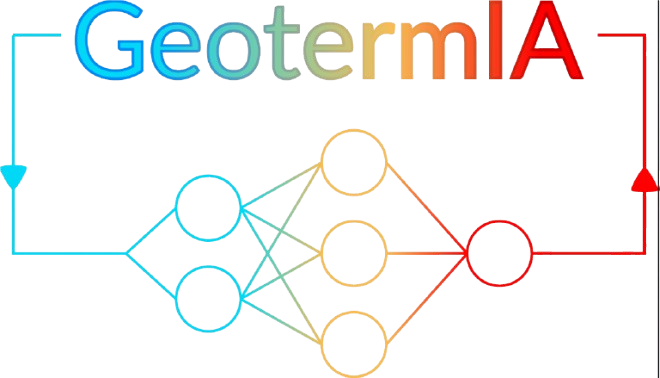
Development of a management and optimization tool for deep geothermal resources using Artificial Intelligence (GeotermIA)
MMT24-IDAEA-01
Deep geothermal energy has the potential to provide sustainable, clean and long-lasting energy resources. Therefore, it plays a strategic role in the energy policies for the coming years. Maximizing the efficiency of this technology and ensuring its profitability is a challenge due to the inaccessibility and uncertainty of the geology consisting of highly heterogeneous fractured rocks, and due to the complexity of the coupled physical processes involved of flow, heat transport and mechanical deformation. The expected growth of this technology manifests the need to manage multiple projects optimally and quickly. The GeotermIA project proposes to develop a tool for the real-time management and optimization of deep geothermal resources through the use of AI, which contributes to the development of digital twins of geothermal facilities.
GeotermIA will develop a deep learning algorithm informed by physics. Training in the identification of patterns and trends useful to improve the efficiency of the geothermal system will be based on historical and synthetic data from simplified, high-fidelity and stochastic numerical models. The tool will allow to evaluate the performance of geothermal systems in real time, identify possible problems and propose optimization solutions, thus providing solid assistance in the decision-making process and contributing to the transition towards more sustainable and clean energy sources.
Funding: Programa Momentum CSIC, Plan de Recuperación, Transformación y Resiliencia - Financiado por la Unión Europea – NextGenerationEU - Ref. MMT24-IDAEA-01
Start Date: 20/11/2024 – End Date: 19/03/2028
Impacto Ambiental del Filtro UV Químico Octocrileno. Identificación de Absorbentes-UV de Origen Vegetal como Ingredientes Ecológicos en Formulaciones de Protectores Solares
PID2023-151815OB-I00
El proyecto ECOSUN tiene como objetivo abordar la posible amenaza ambiental que representa el octocrileno (OC) y explorar dos sustancias presentes en extractos herbales, específicamente quercetina y rutina, como filtros UV alternativos en protectores solares. Esto responde a la necesidad de garantizar la eficacia y seguridad de los productos cosméticos, en particular los de protección solar, teniendo en cuenta su impacto ecológico.
El proyecto tiene un doble objetivo. Por un lado, investigar los efectos ambientales del OC mediante el estudio de su fotodegradación, identificación de metabolitos, adsorción en sedimentos, biodegradabilidad y toxicidad en distintos organismos (líneas celulares, larvas de pez cebra, microorganismos y plantas), además de determinar sus concentraciones ambientales en zonas afectadas. Por otro lado, evaluar la idoneidad de la quercetina y la rutina como filtros UV alternativos, analizando su actividad fotoprotectora y sus perfiles de seguridad para humanos y medio ambiente. Para ello se emplearán técnicas analíticas avanzadas, estudios de degradación y ensayos de toxicidad sin animales, junto con campañas de monitorización ambiental y actividades de difusión dirigidas a la comunidad científica, reguladores, empresas y público general.
Proyecto PID2023-151815OB-I00 financiado por por MICIU/AEI /10.13039/501100011033 y por FEDER, UE
Start Date: 01/09/2024 – End Date: 30/08/2027
Desarrollo de una plataforma inteligente de modelización y virtualización de recursos hídricos
PLEC2023-010215
En la actualidad, en la mayoría de los países del mundo es ejercida una presión sin precedentes sobre los recursos hídricos, con una población creciente y un escenario donde el cambio climático supone un factor de condicionalidad añadido a la escasez de estos recursos. Para el año 2030, según estimaciones de la FAO, la diferencia entre demanda y suministro disponible a nivel mundial será del 40%, realidad a la que, lejos de ser ajena, España es un país muy directamente afectado por esta problemática. En este sentido, las estimaciones de riesgo de desertificación de España, estimadas por el Ministerio para la Transición Ecológica y el Reto Demográfico, hacen saltar todas las alarmas, mostrando que 2/3 partes del territorio español se encuentran potencialmente afectadas por este proceso. Es necesario actuar con urgencia, afrontando el problema con nuevas herramientas, con capacidad y con innovación y E-HYDRO está llamado a ser una herramienta clave para ello.
Ante la problemática e imperiosa necesidad existente, identificada igualmente en la inclusión de esta temática dentro de los objetivos del programa Transmisiones 2023, la solución E-HYDRO dará respuesta mediante la dotación de capacidades altamente innovadoras para la Gestión de los Recursos Hídricos. Así, E-HYDRO permitirá una gestión a nivel Cuenca Hidrográfica y su red fluvial asociada, en la que el usuario contará con un Gemelo Digital de la cuenca, asistido por herramientas de virtualización y modelización con motores de inteligencia artificial específicamente desarrollados. E-HYDRO permitirá así consultar, simular y prevenir escenarios reales o potenciales en aras de la asistencia precisa a la toma de decisiones para la mejor gestión del recurso agua.
Proyecto PLEC2023-010215 financiado por MICIU/AEI/10.13039/501100011033
Start Date: 01/01/2024 – End Date: 31/12/2027
Funding: National Project
https://e-hydro.es/
WATER MANAGEMENT STRATEGIES AND ADAPTATION ACTIONS UNDER A GLOBAL CHANGE CONTEXT FOR THE MEDITERRANEAN REGION
PCI2024-153452
The primary goal of WATER4MED is to provide a robust approach to enhance Mediterranean water governance models by managing water resources sustainably and efficiently, and providing viable alternatives to increase water storage capacity and mitigate floods. Approaches and alternatives to climate change adaptation will be developed and tested in 4 demonstration sites considering the Mediterranean dimension, while their replicability will be assessed in additional Mediterranean sites
Start Date: 01/06/2024 – End Date: 31/05/2027
Funding: International Project
https://water4med.com/
KARST: Predicting flow and transport in complex Karst systems
101071836
Karst aquifers are a treasure and a threat: while up to 25% of the world population depends on them for drinking water, they also have capabilities for extremely fast conduction of water and contaminants. In the light of climate change, we need to prepare for extreme flooding and understand the consequences for karst aquifers. Despite their socio-economic importance, decades of research, and high-profile disasters, karst structures and processes remain notoriously difficult to assess. Because of the complexity of karst and its lack of accessibility, the foundations of flow and transport modeling in karst systems are weak. Key phenomena related to extreme events such as flash floods and heavy tails in tracer recovery are still beyond current modeling capabilities.
KARST will establish the next generation of coupled stochastic modeling frameworks to predict karst processes, assess the vulnerability of karst aquifers, and forecast their response to extreme events. Our approach will bridge structures and processes on all scales, far beyond the capabilities of current theories and computer simulations. This will be achieved by targeting three key objec- tives: (i) Identification and quantification of flow and transport dynamics at the conduit scale. (ii) Characterization and modeling of karst network structure at the catchment scale. (iii) Derivation of a new upscaled approach to predict karst processes at different resolution scales. Together, this will result in an unprecedented multiscale modeling framework for the prediction of flow and transport in karst.
Funded by the European Union. Views and opinions expressed are however those of the author(s) only and do not necessarily reflect those of the European Union or the European Research Council Executive Agency. Neither the European Union nor the granting authority can be held responsible for them. This work is supported by ERC grant (KARST, 101071836, 10.3030/101071836)
Start Date: 01/05/2023 – End Date: 30/04/2029
Funding: European Project
https://erc-karst.eu/
Staff
Permanent Researchers
PhD Students
Postdoc Researchers
Technical







