


The mission of ONHEALTH group is to enhance the understanding of the sources, occurrence, fate and behavior of pollutants of anthropogenic and biogenic origin and their impact on the environment and human health.
The major focus is on engineered systems, aquatic environments, terrestrial habitats, and the exposure to living organisms. To achieve these goals, we employ four main research lines:
1) Chemical and biological analysis to reliably detection and measurement at ultra-trace levels of contaminants in different matrices
2) Conduct controlled conditions experiments at our research facilities
3) Assess the impact of complex mixtures in environment and humans,
4) Assess the biota and human exposure through different routes (dietary, inhalation, dermal).
Our research on organic pollutants focuses mainly on four topics:
- Sampling and Biochemical Analyses
- Impact assessment studies
- Assessment of processes, such as biomagnification or bioaccumulation
- Experiments under controlled conditions
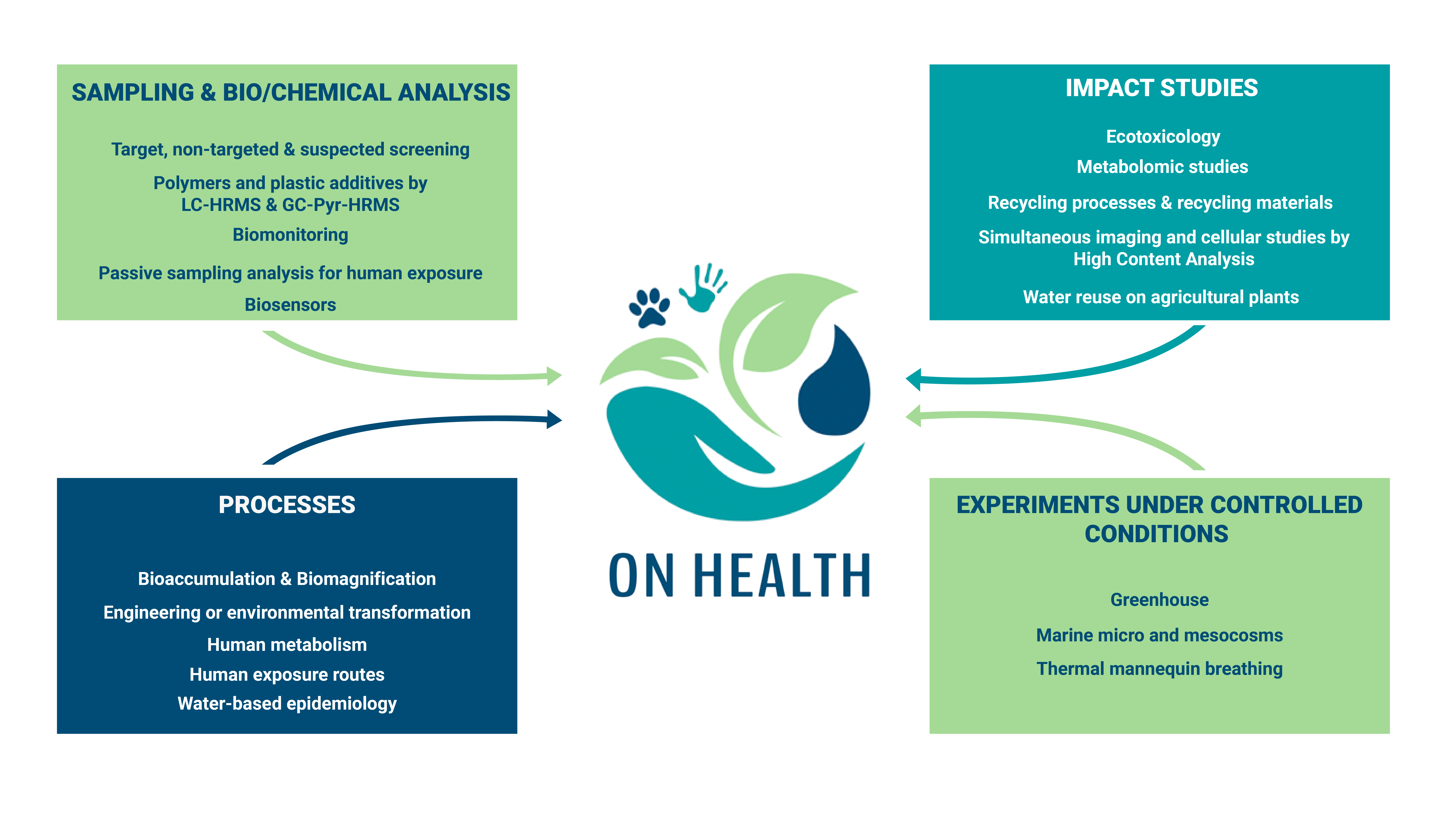
Sampling and chemical and biological analyses to reliably detect and measure at ultra-trace levels contaminants in different matrices, developing:
- sophisticated analytical methodologies (target, suspect and non-target approaches)
- methodologies for the analysis of polymers and plastic additives
- bio and passive sampling
- biosensors
Controlled condition experiments at our research facilities:
- greenhouse for cultivation of crops and installation of nature-based solutions
- marine micro/mesocosm emulating real conditions for accumulation studies and metabolomics studies
- thermal mannequin heads with breading system for the assessment of the real impact of contaminants present in indoor/outdoor or in different materials through breathing
Impact assessment through studies of:
- toxicological studies: standardized ecotoxicity tests, cell-lines toxicological studies with high-content analysis (HCA)
- metabolomic studies based on high resolution mass spectrometry
- impact of recycling processes and recycled materials
- water reuse on agricultural crops
Assessment of different processes, such as:
- bioaccumulation and biomagnification of pollutants along aquatic and terrestrial food chains
- transformations in natural or engineered systems
- human metabolism for exposure assessment
- water-based epidemiology
- human exposure through different routes: diet, inhalation and dermal contact
Our strategic plan is based on the development of frontier research and the training of new researchers together with an intense and effective fund raising through competitive calls and collaborations with public bodies and private companies.
ONHEALTH has an extensive network of collaborations:
- At national level: ACA, Agència de Residus de Catalunya, Agència de Salud Pública de Catalunya, Banco de Leche-Banc de Sang i Teixits de Catalunya, ICMAN, ICRA, IEO, ISGlobal, UB, UAB, UV, URiV, Parque Nacional de Doñana, Parque Nacional Tablas de Daimiel, Bioinicia S.L., ARPE S.L.
- At international level: University of New York (Buffalo, USA), CAPSENZE (Sweden), CONICET (Argentina), Universidad de Jijel (Algeria), CERTE (Tunisia), Florida International University (Miami, USA), Hebrew University of Jerusalem (Israel), UFZ (Germany), Université de Montpellier (France), INL (Portugal), RWTH (Germany), TUD (Germany), NIVA (Norway), IPMA (Portugal), among others.
Research Facilities
Instrumentation for chemical analysis
Sample collection, preparation and extraction:
- Freezer/Mill
- Quechers multi vortex
- Thermo block for incubation of human assays
- Evaporator SyncorePlus Analyst to perform a fast and gentle evaporation process with vacuum-vortex evaporation
- Extraction and purification of liquid samples by off-line solid phase extraction techniques.
- On-line extraction and purification:
- Turbulent flow chromatography (TurboFlow, Thermo Fisher) coupled to LC-QqQ-MS
- EQuan (Thermo Fisher Scientific) coupled to LC-QqQ-MS
- Extraction of solid samples:
- Pressurized liquid extraction – ASE 350 (Dionex)
- ONE PSE (Applied Separations)
Analysis by means of liquid chromatography coupled to mass spectrometry (LC-MS):
- Target analyses: LC-QqQ-MS, TSQ Vantage (Thermo Fisher Scientific)
- Suspect and non-target analyses: UHLPC-Orbitrap-MS, Q-Exactive (Thermo Electron)
Antropogenic particles (micro/nanoplastics and nanomaterials equipments)
- Spectrophotometer (Jenway 6062)
- Swift M10 Advanced Binocular Microscope
- Nanotracking analysis
- Pirolysis
Ecotox and biosensors lab
- Microtox® system (Azur)
- Spectrophotometer (Jenway 6062)
- ToxAlert 100 (Merck)
- Abratox Camera (Abraxis)
- Incubators with lateral illumination (Aqualytic)
- Cellular toxicity suit
- High content analysis (HCA) facilities
- Cell-lines suit access
- Cell-Insight NxT reader (Thermo)
- CellCense – Amperometric whole cell biosensor
- Microliter Plate readers and washers
Controlled conditions experiment facilities
- Greenhouse for cultivation of crops and installation of nature-based solutions
- Marine microcosms and mesocosms
- Thermal mannequin heads with breathing system

Sistemas Urbanos de Drenaje Sostenible de Nueva Generación para Maximizar el Rendimiento Bajo Eventos Extremos
PID2025-176518OB-I00
Proyecto PID2025-176518OB-I00 financiado por MICIU/AEI /10.13039/501100011033 y por FEDER, UE
Start Date: 01/10/2026 – End Date: 30/09/2029
Reducing Impact of Plastic Pollution through Learning & Engagement
101296045
Plastic pollution in rivers is one of the fastest-growing threats to marine ecosystems, with the majority of ocean plastics originating upstream. RIPPLE addresses this challenge at its source, preventing plastics from entering rivers and ultimately the sea. By combining design thinking, makers innovation, citizen science, and open participatory tools, RIPPLE offers a novel, community-driven approach that goes beyond cleanup. The project raises awareness, educates, and empowers citizens and local stakeholders to change behaviors, while also transforming collected plastics into valuable resources through affordable, accessible maker technologies.
RIPPLE builds a multi-layered framework where prevention, education, and reuse create small but powerful changes – ripples – that expand into systemic impact. Through accessible design interventions, participatory monitoring, and creative reuse of plastics, the project mobilises local communities, schools, and citizens as co-creators of solutions. This integrated approach ensures that fewer plastics reach rivers in the first place, while those that do are transformed into opportunities for learning, creativity, and innovation.
This project has received funding from the European Union’s Horizon Europe research and innovation programme under grant agreement No 101296045.
Start Date: 01/09/2026 – End Date: 31/08/2030

Innovative monitoring tools and management strategies for ensuring Water quality in evolving climate change scenarios
2023 BP 00079
InWater aims to develop and evaluate cutting-edge, monitoring tools to examine the effects of climate change as part of a sustainability assessment, to integrate existing chemical data with new potential data of organic pollutants from freshwaters and soil. The research will employ various models aimed at understanding the current state of freshwater bodies, monitoring the fate of contaminants over time, and predicting future scenarios of potential risks associated to the presence of CECs in the Mediterranean area of Catalonia to address the growing concern over water safety. The project will provide new strategies, tools, guidelines, and recommendations for adaptive water management, making data accessible to stakeholders, including urban water authorities, urban users and farmers, as well as decision-makers, to establish new risk-oriented urban water management plans for the protection of freshwater bodies.
Start Date: 01/01/2025 – End Date: 31/12/2027
REDUCING PLASTICULTURE IMPACTS ON WATER RESOURCES AND ENHANCING RESILIENCE IN MEDITERRANEAN AGRICULTURE (MED-AGRIPLAST)
PCI2026-177439-1
This work has been supported by the MED-AGRIPLAST project (PRIMA/SECTION 2 2025 - MULTI-TOPIC). The project is funded by the Partnership for Research and Innovation in the Mediterranean Area (PRIMA), co-funded by the European Union, and by the Spanish Ministerio de Ciencia, Innovación y Universidades / Agencia Estatal de Investigación (AEI) through grant number PCI2026-177439-1.
Start Date: 01/06/2026 – End Date: 31/05/2029

Tracking marine pollutant cocktails and their ecological impact with advanced analytical, technological and toxicological tools
101291975
SEATRACE will deepen knowledge of marine pollution by characterizing complex cocktails of marine pollutants (MrPs) in coastal regions of the Atlantic, Arctic and Indian Oceans, and Mediterranean Sea. This will be accomplished by determining hazardous MrPs and assessing their toxicity on key marine organisms across global climate change and their cumulative effects on marine communities and human health. Active and passive sampling approaches, bio/chemical analytical methods, aquatic sensors and drones, and next-generation cumulative risk assessment will be applied. A key innovation is the integration of the monitoring tools with effect-based methods (EBMs) including effect-directed analysis (EDA) to identify and prioritize hotspots at risk and toxic components within MrPs mixtures, enhancing the accuracy of ecological and human health risk assessments. The human exposure to seafood-borne MrPs will be assessed in seafood health and economy, providing strategies to enhance seafood safety confidence and support fisheries trust.
SEATRACE will strengthen European Union (EU)-India research collaboration on MrPs and plastic litter through the joint work of EU and Indian organization. Additionally, the Indian partners will apply innovative pilot solutions to reduce marine plastics at key hotspots, including waste recycling to meet national requirements. They will contribute with expertise across the seawater management value chain, from knowledge providers to end-users. SEATRACE will address the following mid-term outcomes: i) exploitation of four monitoring tools including Passive sampling (chemical, plastic litter, and parasitic copepods), bacterial and human cell-based new approach methods (NAMs), optical sensors and drones and the application of EBMs/EDA to marine environments; ii) development of robust, evidence-based tools and models for risk assessment and policy-making at local and global scales; and iii) fostering EU–India cooperation for harmonized and effective protection of marine ecosystems and public health.
This project has received funding from the European Union’s Horizon Europe research and innovation programme under grant agreement No 101291975.
Start Date: 01/09/2026 – End Date: 31/08/2030
Distintivo FUNDS SYG 2025 en el IDAEA
FUNDS25132
Start Date: 01/01/2025 – End Date: 31/12/2026
Pro-ERC IDAEA
FUNDS25077
Start Date: 01/01/2025 – End Date: 31/12/2026
Distintivo FUNDS STG/COG/ADV/SYG-01 2024 en el ¿INSTITUTO DE DIAGNOSTICO AMBIENTAL Y ESTUDIOS DEL AGUA¿ del CSIC)
FUNDS24053
Start Date: 01/01/2024 – End Date: 31/12/2026
Proyecto integral de apoyo a la investigación: gestión, captación de fondos y comunicación científica
202580E133
PROYECTOS INTRAMURALES CSIC(2022)
Start Date: 01/07/2025 – End Date: 31/12/2026
Contaminantes orgánicos emergentes: presencia en el medio ambiente y rutas de exposición humana
202580E181
PROYECTOS INTRAMURALES CSIC(2022)
Start Date: 01/09/2025 – End Date: 31/08/2028
Staff
Permanent Researchers
PhD Students
Postdoc Researchers
Technical







